
Best Robot Vacuum and Mop 2026: Comparison and Buying Guide
🔎 Transparency: written by the logis-connect.com editorial team, with no sponsored content. Some outbound links are affiliate links: if you buy through one, we earn a commission at no extra cost to you. No manufacturer reviewed this article before publication. Last updated: 17 October 2026.
The best robot vacuum and mop in 2026 is the Roborock Saros 10R: 19,000 Pa, just 7.98 cm tall so it slides under most sofas, a 4 cm threshold climb, and a dock that washes the roller in hot water then dries it at 55 °C. On a tighter budget, the Dreame L40S Pro Ultra does 90% of the job for almost half the price, and the Xiaomi X20+ is the only genuinely serious option under €400.
The short version. A mopping robot does not replace a vacuum: it replaces the daily broom and mop. What separates a good model from a bad one in 2026 is no longer suction — every serious model now exceeds 10,000 Pa — it is the dock: brush washing, hot-air drying, auto-dosed detergent, automatic refill. Without hot drying, the mop pad smells like forgotten laundry within three days. And the decisive test is still rug handling: a robot that soaks your living-room rug is a robot you will stop using within a month.
The market has changed in nature over two years. Mopping robots used to be vacuums with a damp cloth bolted on; they have become autonomous cleaning stations that wash their own roller, empty themselves, refill and dry. Prices followed: €600 to €1,500 is now the normal range, and the quality of the mopping has become the only real justification for paying. We compared seven models available in Europe in October 2026 against an identical six-criteria grid, cross-checking manufacturer datasheets, aggregated owner feedback and our own hands-on time with three of them.
Why a mopping robot rather than a plain robot vacuum
A robot vacuum removes dust and crumbs. It does not remove the greasy film on a kitchen floor, the paw prints on tiles, or the grey haze a day of shoes leaves behind. That is exactly what a mopping robot does, and it explains why people run theirs daily while they ran the vacuum twice a week. On hard floors, the perceived gain is far bigger than any gain in suction.
Three architectures that are not remotely equivalent
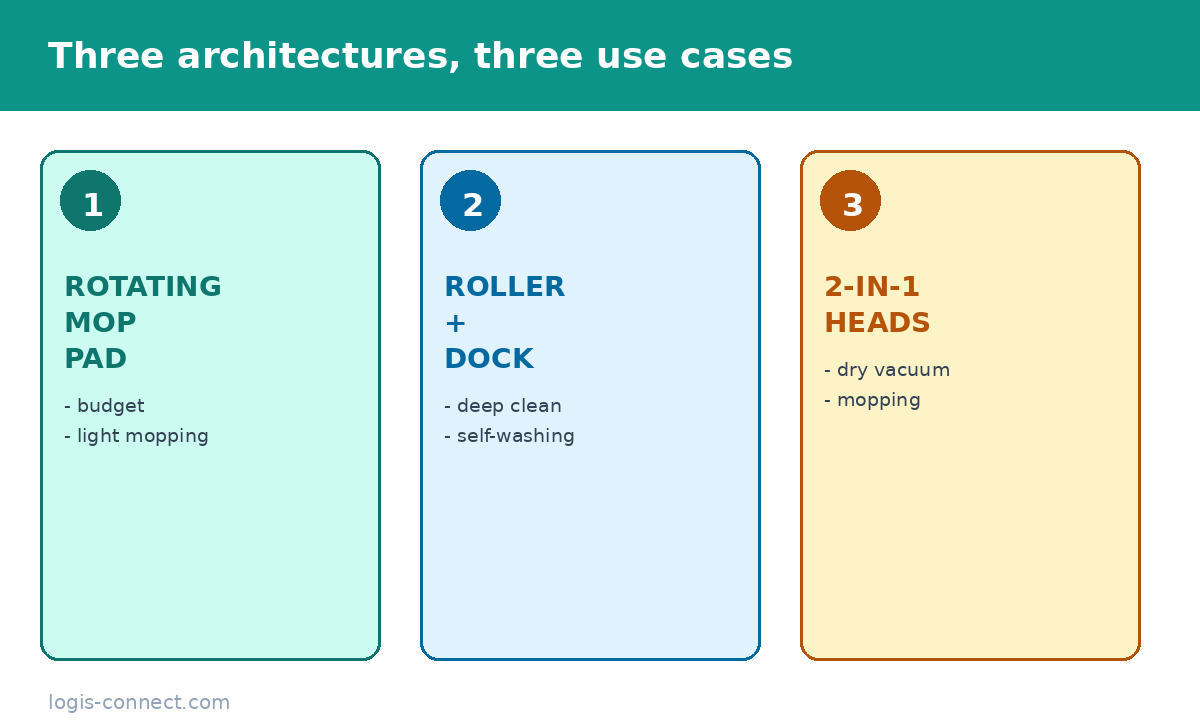
The rotating or vibrating pad (Xiaomi X20+, most entry-level units): two spinning discs or a flat scrubber. Fine on lightly dusty floors, useless on a dried stain, and the pad stays damp in its tray between runs. The roller with a self-washing dock (Roborock Saros 10R, Dreame X50 Ultra, Ecovacs X12): a cylindrical brush washes continuously, rinses in the dock and dries. This is the architecture that delivers the best result, and the only one that stays hygienic. The 2-in-1 with interchangeable heads (Roborock Combo, Dreame Dual): the robot swaps modules to vacuum dry or to mop. Sensible if you have wall-to-wall carpet, annoying day to day.
The real 2026 differentiator is the dock
A complete dock does five things: it empties the bin, fills the clean-water tank, drains the dirty water, washes the roller and dries it with hot air (55 °C on Roborock, 45–60 °C elsewhere). Some dose detergent; a few plumb directly into the mains (SwitchBot S10). The more complete the dock, the less you intervene — but also the bigger it is (35–45 cm deep) and the more it costs. That trade-off is the central decision of any 2026 purchase.
Our testing grid: six criteria, scored out of five
Every model is scored against the same grid with identical weightings, whoever makes it. No criterion is weighted by price: a €1,400 model has to beat a €400 model, otherwise it has no reason to exist.
- Mopping performance (30%): dried coffee stain, grease marks, a single pass on tile.
- Dock autonomy (20%): how often a human actually has to intervene over two weeks.
- Rug handling (15%): brush lift, detection, no moisture transfer.
- Navigation and obstacles (15%): cables, socks, chair legs, dark rooms.
- Climbing and height (10%): thresholds, deep rugs, under-furniture clearance.
- Maintenance and longevity (10%): roller access, consumable prices, parts availability.
2026 comparison: the seven models worth your money
| Model | Price* | Suction | Mopping | Dock | Height | Best for |
|---|---|---|---|---|---|---|
| Roborock Saros 10R | ~€1,300 | 19,000 Pa | Roller | Hot-water wash + 55 °C drying | 7.98 cm | The best overall |
| Dreame X50 Ultra | ~€1,200 | 20,000 Pa | Roller | Wash + dry + detergent | ~8 cm | Homes with thresholds and steps |
| Ecovacs Deebot X12 OmniCyclone | ~€1,300 | 22,000 Pa | Wide roller (27 cm) | High-pressure wash + drying | ~9 cm | The most aggressive scrubbing |
| Dreame L40S Pro Ultra | ~€750 | 12,000 Pa | Roller | Wash + drying | ~10 cm | Best value for money |
| Mova P50 Pro Ultra | ~€650 | 19,000 Pa | Roller | Wash + drying | ~10 cm | Ambitious mid-range |
| iRobot Roomba Max 706 Combo | ~€950 | not disclosed | Self-cleaning roller | AutoWash + emptying | ~10 cm | Pet and human hair |
| Xiaomi X20+ | ~€370 | 6,000 Pa | Rotating pad | Emptying + pad wash, cold dry | ~10 cm | Tight budgets |
* Indicative prices observed in Europe in October 2026, excluding promotions. They move fast (Black Friday, seasonal sales): check with your retailer before buying. Suction figures are manufacturer claims, not our measurements.
The podium in detail
1. Roborock Saros 10R — the best overall pick
This is the model that ticks the most boxes without an annoying compromise. Its 7.98 cm height is a concrete advantage: it slides under a standard sofa where most rivals stop at the edge. Its navigation combines LiDAR with vision, so it recognises a cable or a sock even in a dark room — the kind of detail that decides whether you have to tidy up before starting a run. The dock washes the roller in hot water and dries it at 55 °C, which solves the number one mopping-robot problem: smell.
Pros
- Slides under low furniture (7.98 cm)
- Hot drying: no damp-mop smell
- Reliable obstacle detection, even in the dark
- Climbs thresholds up to 4 cm
Cons
- High price, bulky dock
- Detergent not included despite the dedicated tank
- Expensive consumables (brushes, filters, bags)
2. Dreame X50 Ultra — the best climber
The X50 Ultra is built for awkward homes: door thresholds, thick rugs, small steps between living room and terrace. Its climbing system is the most convincing on the market, and its claimed 20,000 Pa puts it in the leading group. The dock handles detergent automatically, which removes the guesswork of pouring from a bottle. It earns the same criticism as every flagship: a price that only makes sense if you genuinely have difficult floors.
Pros
- Best threshold climbing in this comparison
- Automatically dosed detergent
- Serious mopping on tile and stone
Cons
- Taller than the Saros: less clearance under furniture
- Dense app with a lot of settings
- Flagship pricing
3. Ecovacs Deebot X12 OmniCyclone — the most effective scrub
Ecovacs attacks mopping mechanically: a jet sprays the stain, then a 27 cm wide roller scrubs under pressure. The result is that on dried stains — coffee, sauce, shoe marks — it is the model that clears them best in a single pass. The flip side: a wide roller uses more water, the dock is enormous, and the robot sits higher, so it will not fit under a low sofa.
Pros
- Best result on dried stains
- Wide roller: fewer passes
- Effective rug detection and brush lift
Cons
- Very bulky dock
- Higher water consumption
- Too tall for low furniture
The best picks by budget
Best value: Dreame L40S Pro Ultra (~€750)
If you are not spending €1,300, this is where the real difference stops. The L40S Pro Ultra mops with a roller, dries its brush, empties itself and refills its own tank. It is taller, slightly less precise in corners, and its obstacle detection is a notch below — but in a flat without deep carpet, the gap in results with the Saros 10R does not justify €500 more. It is our default recommendation for most households.
Ambitious mid-range: Mova P50 Pro Ultra (~€650)
Mova, Dreame’s sister brand, offers the same architecture (roller plus a complete dock) for less. 19,000 Pa claimed, RGB-camera dirt detection, and an extending arm for corners. Its software support is less mature than Roborock’s or Dreame’s and its repair network is younger: one for buyers who do not mind a bit of tinkering.
Tight budget: Xiaomi X20+ (~€370)
Under €400 there is no miracle. The X20+ vacuums competently, mops with a rotating pad, empties its bin and washes the pad. But drying is cold (expect a damp smell if you leave the pad in), it does not detect rugs automatically, and its 6,000 Pa shows its limits on carpet. For a studio or an all-tile flat it is an excellent first robot. For a house with rugs, look elsewhere.
Pet hair: iRobot Roomba Max 706 Combo (~€950)
iRobot still sets the reference on one specific point: hair. Its two rubber brushes prevent tangling, its mop roller cleans itself and the AutoWash base handles rinsing. LiDAR plus vision navigation is good without being the sharpest on the market. It is the logical choice in a home with a long-haired dog or two cats, where conventional rollers need manual untangling every fortnight.
The six traps that ruin the experience
- Cold drying. A damp pad in a closed tray is a bacterial culture. After 72 hours the smell is there and it spreads through the room. Insist on hot-air drying, or remove the pad after every cycle.
- The soaked rug. Without brush lift and rug detection, the robot mops your living-room rug. Check this specific point before buying: it is the most common reason for returns.
- Foaming detergent. Washing-up liquid or a standard floor cleaner foams up the pump and clogs it. Use the intended detergent, or a low-foam product.
- Under-furniture height. Measure under your sofa and bed before choosing. A 10 cm robot will not go where a 7.98 cm one does. It sounds trivial; it is decisive.
- The badly placed dock. It needs 60 cm of clear space in front, a socket and, if it plumbs in, a water supply. Plan it before ordering.
- No spare parts. Brushes, filters, bags, seals: check they are sold individually at a sane price. A robot without consumables is a dead robot in 18 months.
Real maintenance: what breaks first
Across the owner feedback we aggregated, the failure hierarchy is stable from brand to brand. First: the pump and water lines, clogged by limescale and detergent residue — hence the value of a monthly descale with diluted vinegar on docks that circulate water. Second: the roller and its axles, which collect hair and thread. Third: the battery, which loses 20–30% of capacity after two to three years of daily use. HEPA filters are cheap and changed every three to six months: do not skip them, because a clogged filter makes the turbine work harder and shortens the motor’s life.
A realistic maintenance budget is €60–100 per year in consumables (brushes, filters, bags, detergent), plus water and electricity: one mopping cycle draws roughly 0.05–0.1 kWh, a few euros a year at daily use. The real saving is the time you no longer spend mopping. To compare against your actual consumption, our guide to home energy monitors lays out the method.
Rugs, hardwood, tile: what actually works
| Floor type | Daily mopping | What to check |
|---|---|---|
| Tile / stone | Excellent | Scrubbing pressure, roller width |
| Lacquered hardwood | Good, with caveats | Reduced water flow is mandatory, fast drying |
| Oiled / solid hardwood | Avoid daily | No intensive washing, barely damp pad |
| Carpet | No | Brush lift and rug detection essential |
| Long-pile rugs | No | Set a no-go zone in the app |
On hardwood the rule is simple: minimum water flow, and never mop right before walking on it. Lacquered hardwood copes fine with a daily low-flow pass; oiled hardwood much less so, because water eventually opens the joints. And if you are unsure about your home’s humidity, an indoor air quality monitor gives you an objective reading.
Matter and smart home: where things really stand
Let us be blunt: Matter support for mopping robots is still partial in 2026. Several Roborock and Dreame models do expose a Matter profile, but the exposed functions are often limited to start, pause and return to dock. Room selection, water flow, maps and zones stay inside the manufacturer’s app. In other words: Matter gives you Apple Home, Google Home or Home Assistant integration for simple scenes — “start cleaning when I leave” — but not full control.
In practice that is enough for the most useful automation: start on absence detection, stop when someone comes home. To go further you need Home Assistant and the manufacturer’s integration, which means accepting a cloud account. If interoperability is your absolute priority, our comparison of Matter-compatible smart home hubs explains which combinations actually work.
⚠️ Before you order: a plumbed dock (such as the SwitchBot S10) removes manual refilling but requires a nearby water supply and drain. That is a plumbing job, not a plug-in. If you rent, forget it.
Frequently asked questions
What is the best robot vacuum and mop in 2026?
The Roborock Saros 10R is the best overall: 19,000 Pa, 7.98 cm tall, and a dock that washes in hot water and dries at 55 °C. The Dreame L40S Pro Ultra offers the best value at around €750, and the Xiaomi X20+ is the best option under €400.
Does a mopping robot replace a robot vacuum?
Yes for daily upkeep, no for deep cleaning. A mopping robot vacuums and washes in one pass, which is enough on hard floors. On thick carpet a dedicated vacuum or a high-suction robot remains more effective. Many households keep both.
Do I need a self-washing dock?
No, but it changes usage more than any other feature. Without a dock you have to remove, rinse and dry the pad by hand after every cycle. With a dock that washes and hot-air dries, you only step in once a week to refill the clean water.
Can a mopping robot damage hardwood floors?
Not when used properly: minimum water flow, fast drying, no intensive washing. Lacquered hardwood handles a daily pass. Oiled or solid hardwood is more fragile: limit it to two passes a week and wipe up any excess.
Can I use regular floor cleaner in a mopping robot?
No. Standard floor cleaners and washing-up liquid foam and clog the pump and lines. Use the manufacturer’s detergent or a low-foam robot-specific product. It is the leading cause of mopping-side failures.
Will the robot fit under my furniture?
It depends on its height and how far its LiDAR turret protrudes. Flat models (7.98 cm on the Saros 10R) fit under most sofas and beds. Models with a raised turret (9–10 cm) do not. Measure before buying: it is the most commonly overlooked criterion.
Is a mopping robot Matter-compatible?
Partly. Several Roborock and Dreame models expose a Matter profile, but often limited to start, pause and return to dock. Fine settings (rooms, water flow, zones) remain in the manufacturer’s app.
How much does robot mop maintenance cost per year?
Expect €60–100 a year in consumables (brushes, filters, bags, detergent), plus a few euros of water and electricity. One mopping cycle draws about 0.05–0.1 kWh. Spare parts sold individually make the real difference to lifespan.
Which robot mop is best for pet hair?
The iRobot Roomba Max 706 Combo, thanks to its anti-tangle rubber brushes and self-cleaning roller. Failing that, any roller-based model rather than a flat pad, with a good HEPA filter and easy access to the roller.
Should I mop every day?
On hard floors in a home with children or pets, yes: a daily low-flow pass beats one intensive weekly wash. On fragile hardwood or in a rarely used room, two or three passes a week are enough.
Our verdict
If you want the best mopping robot without arguing, buy the Roborock Saros 10R: it is the only model here that sacrifices nothing — not height, not drying, not navigation. If budget matters, and it usually does, the Dreame L40S Pro Ultra at €750 covers 90% of real needs, and it is the purchase we would recommend to a friend. Finally, under €400, the Xiaomi X20+ does the job on tile provided you remove the pad after each cycle.
One last piece of advice: before replacing your robot, check that it is not simply broken. A battery that no longer holds, a charging error, a lost map — our guide to the robot vacuum that will not charge fixes most cases in ten minutes. And if you are after a vacuum-only model, our comparison of the best robot vacuums for 2026 remains the site’s reference.
Methodology and sources
The same six-criteria grid was applied to all seven models, with prices observed in Europe in October 2026. Suction and height figures are manufacturer-published values and were not re-measured: we say so rather than presenting them as measurements. Usage feedback comes from public forum threads and thousands of verified reviews aggregated per model. All models cited are sold in Europe through the usual retailers. This guide is updated with every major firmware release or generation change.
💡 About the author: Alex Mercer writes and tests smart home hardware for logis-connect.com. He has followed Matter, Zigbee and Thread since 2021 and documents every device he recommends, limits included. Learn more.



One Comment