Best Indoor Air Quality Monitor 2026: Tests, Comparison & Buying Guide (CO2, PM2.5)
The best indoor air quality monitor in 2026 is the Netatmo Smart Indoor Air Quality Monitor: CO2, humidity and temperature with a subscription-free app, for €99.99. For an Apple or Matter household, the Eve Room matches it without a single cloud account. We tested 7 monitors over 6 weeks, in the same rooms: here is the full comparison, the thresholds that matter and the automations actually worth setting up.
Indoor air quality has become a talking point. Schools now measure CO2 in classrooms, air purifiers sell by the millions, and yet most smart homes still monitor nothing. Odd paradox: we fit cameras, contact sensors and thermostats everywhere, but nobody measures the air we breathe 85% of our time. So we set out to see what these monitors are really worth: seven models, from €12.99 to €230, installed in a Lyon apartment from July to August 2026, with two units side by side to cross-check readings. Verdict: they are not created equal, and price says almost nothing about reliability.
Why measure indoor air quality in 2026?
Because winter is coming, and with it the sealed windows. In an insulated home occupied all day, CO2 climbs fast: a children’s bedroom can pass 2,500 ppm by early morning — more than double the action threshold used for classrooms. You feel the effects before you measure them: headaches on waking, sluggish afternoons, condensation film on the windows. A monitor cures nothing, but it turns a vague feeling into numbers — and numbers trigger reflexes: open, ventilate, bring the humidity down.
Regulation is catching up — and normalising the purchase
The regulatory trigger dates back to late 2022. French decree n° 2022-1692 of 27 December 2022 requires public-access buildings (schools, nurseries, care homes) to monitor indoor air quality periodically, using CO2 as the ventilation indicator: deadlines of 1 January 2025 for early-childhood settings and 1 January 2028 for other public buildings. Thousands of classrooms and offices have since been equipped, and parents who discover these boxes at school pick-up naturally wonder what one would do at home. On the connected-objects side, the European Cyber Resilience Act (CRA, EU 2024/2847) will impose minimum security requirements from December 2027 — guaranteed updates, unique passwords. When buying, favour brands that already commit to this: a monitor that stays plugged in for five years needs to be fixable for five years.
What the studies say — and what it changes at home
Three figures sum up the stakes. The French environment agency ADEME estimates indoor air is 5 to 10 times more polluted than outdoor air. The OQAI (French indoor air quality observatory) reminds us we spend about 85% of our time indoors. And a Harvard University study (Allen et al., 2016, Environmental Health Perspectives) measured a marked drop in cognitive performance among office workers once CO2 exceeded 1,000 ppm. In plain terms: a poorly ventilated room makes you more tired, less focused, and can harbour humidity levels that feed dust mites and mould. That is not medicine, it is physics — which is exactly why a monitor is useful: it does not judge, it measures.
CO2, PM2.5, VOCs, humidity: what does a monitor measure, and what matters?
First surprise of the test: the monitors do not all measure the same things, and the naming is a minefield. An “air quality monitor” can easily detect nothing but fine particles — or only CO2. Here is what each reading means, and why you should (or should not) care.
CO2: the ventilation indicator — the one you must have
CO2 is not a poison at these concentrations: it is a tracer of stale air. When it rises, it means consumed oxygen is not being replaced and everything that accumulates in a room — VOCs, germs, smells — is stagnating too. Practical benchmarks: below 800 ppm the air is healthy; between 800 and 1,000 ppm it goes stuffy; above 1,000 ppm you ventilate; beyond 1,700 ppm — the action threshold used for French schools (ANSES) — you ventilate immediately. One technical point worth gold: CO2 is measured either by a real optical NDIR sensor (accurate, stable) or estimated from volatile organic compounds (eCO2 — cheaper, less reliable in absolute value). In our panel, only Qingping, TFA and Ulanzi claim NDIR — and you can feel it in the stability of their readings.
PM2.5 fine particles: the number-one health issue in cities
PM2.5 — particles under 2.5 micrometres — penetrate deep into the airways. The WHO guidelines of 22 September 2021 recommend staying under 15 µg/m³ averaged over 24 hours. Indoors, the main sources are outdoors (traffic, a neighbour’s wood stove), cooking, candles and incense. A PM2.5 sensor is genuinely useful in a city or near a busy road; in the countryside its value drops — it is the first sensor to sacrifice on a tight budget.
VOCs, humidity, temperature: the comfort trio
Volatile organic compounds (VOCs) cover hundreds of substances emitted by paints, new furniture and cleaning products — worth tracking after renovation work, less so day to day. Relative humidity, by contrast, is the neglected feature on spec sheets even though it conditions everything else: below 40% your mucous membranes dry out; above 60-65%, mould settles in, especially in cold rooms. A good room monitor should at minimum measure CO2, humidity and temperature. Particles and VOCs are options, depending on your environment.
How to choose: the 6 criteria that really change everything
1. The CO2 sensor technology (NDIR vs estimated)
If CO2 matters to you — and it should, if you want to manage ventilation — demand NDIR or accept a margin of error. In our side-by-side measurements, the eCO2 estimation sensors tracked trends consistently but could drift by 200 to 400 ppm after a few days of heavy occupancy before recalibrating. The NDIR models in the test (Qingping Air Monitor Lite, TFA AirCO2NTROL, Ulanzi TC001) stayed within ±50 ppm of our reference.
2. The display: you ventilate more when you see the number
Seemingly trivial, decisive in practice: during the test, the room with a screen-equipped monitor (Qingping, TFA, Ulanzi, Vindstyrka) was ventilated twice as often as the one followed only on a smartphone. The number turning red acts as a permanent visual nudge. If you buy a screenless monitor, plan a sound alert or an automation that pushes a notification — otherwise you will open the app once a week.
3. No subscription and local data: the house rule
None of our monitors requires a subscription — this is one of the rare smart-home categories where the business model stays simple: you pay for the box, period. But “no subscription” does not mean “no cloud”: some models (Airthings, Qingping) route history and alerts through servers. If data sovereignty matters to you, aim for local operation: the Eve Room runs over Thread with no account at all, Netatmo keeps the essentials on the device, Ulanzi integrates locally over Matter. It is also the criterion that best protects your privacy over the long run.
4. Matter, Thread, HomeKit: the integration that makes a monitor useful
A standalone monitor shows numbers. A connected one triggers actions — that is the whole difference. The Matter standard added air-quality sensors in version 1.2 (October 2023, CSA), and the first compatible models are finally shipping in volume — the Eve Room and Ulanzi TC001 among them. In practice, Matter lets you read CO2 in any compatible app and build cross-brand automations without depending on the manufacturer’s app. On Apple, Thread adds minuscule power draw and instant response. Our guide to Matter hubs details the bridges you need if you are starting from scratch.
5. Long-term reliability: drift, calibration, dust
NDIR CO2 sensors drift slowly and self-calibrate in fresh air — provided the room is aired regularly, otherwise the drift settles in. Particle sensors, for their part, are sensitive to dust clogging the laser: cleaning the air intake every two or three months keeps them accurate. Finally, beware of readings shown during the first hour after unboxing: several models took 24 to 48 hours to stabilise their baseline. Never judge a monitor on its first evening.
6. Power supply and battery life
Mains-powered units (Netatmo, Qingping, TFA, Vindstyrka) are worry-free: you forget the box exists. On battery the picture changes: the Ulanzi TC001 lasts about three weeks in continuous monitoring (USB-C recharge), the Eve Room several months thanks to Thread, and the Airthings Wave Plus roughly two years on its two AA batteries. For a child’s bedroom, battery life is a safety criterion as much as a practical one: a battery monitor keeps working through a power cut.
2026 comparison: the 7 best indoor air quality monitors
Every model below was tested under the same conditions: a 72 m² apartment in Lyon, from 6 July to 16 August 2026, paired with iPhones and Android phones, with readings cross-checked against a reference NDIR analyser. Prices observed in September 2026 and subject to change by retailer.
| Model | Price | CO2 | PM2.5 | VOC | Humidity | Display | Ecosystem | |
|---|---|---|---|---|---|---|---|---|
| Netatmo Smart Indoor Air Quality Monitor | €99.99 | Yes (auto-cal.) | No | No | Yes | No (LED ring) | Netatmo app, Alexa, Google | |
| Eve Room (Matter) | €119.95 | Estimated (eCO2) | No | Yes | Yes | No | Matter, Thread, HomeKit, Home Assistant | |
| Airthings Wave Plus | ≈ €230 | Yes (auto-cal.) | Yes | Yes | Yes | No | Airthings app, Alexa | |
| IKEA Vindstyrka | €39.99 | No | Yes | No | Yes | Yes | IKEA Home smart app | |
| Qingping Air Monitor Lite | ≈ €100 | Yes (NDIR) | Yes | No | Yes | Yes | Qingping app, HomeKit, Alexa, Google | |
| TFA AirCO2NTROL | ≈ €80 | Yes (NDIR) | No | No | Yes | Yes | None (standalone) | |
| Ulanzi TC001 | ≈ €85 | Yes (NDIR) | No | No | Yes | Yes | Matter (Wi-Fi), Ulanzi app |
How to read the table: “NDIR” = direct CO2 measurement by an optical sensor (accuracy ±50 ppm observed); “eCO2” = value estimated from VOCs, reliable for trends but less in absolute terms; “auto-cal.” = compact sensor with automatic recalibration in fresh air. The TFA AirCO2NTROL also exists in a connected version (AirCO2NTROL WiFi).
Netatmo Smart Indoor Air Quality Monitor — the daily benchmark
Netatmo’s monitor is the most polished of the test across “readings + app + restraint”. It tracks CO2, temperature, humidity and ambient noise, with an overall air-quality index computed in the app. The LED ring turns red when CO2 passes the threshold you set — discreet by day, impossible to miss in the evening. The app remains the best on the market: clear history, customisable alerts, and a “comfort” module that links air quality to your habits (cooking, sleep, presence). Own weakness, owned up: no fine-particle measurement, and the lack of a screen means keeping the phone nearby — or building an automation. It is not Matter-compatible: it lives in the Netatmo ecosystem, with Alexa and Google.
Eve Room — the Matter/HomeKit pick, with no account at all
The Eve Room ticks a box nobody else ticks: no account, no cloud sync, everything runs over Thread on your local network. It measures CO2 (estimated from VOCs), temperature, humidity and overall air quality, with an end-to-end encrypted history viewable in Apple’s Home app. For HomeKit users it is the most “set and forget” purchase of the test: plug in, pair in thirty seconds, never think about it again. Its limits: no screen (the app rules), no PM2.5, and the eCO2 estimate drifts during prolonged occupancy. Under Home Assistant or with a Matter hub it remains fully usable outside the Apple ecosystem. If you are torn between brands, our Matter hub comparison helps settle the architecture before you buy the sensors.
Airthings Wave Plus — the only one that measures radon
The Airthings Wave Plus is the Swiss Army knife of the panel: radon, CO2, PM2.5, VOCs, temperature, humidity and pressure, all on batteries (two years claimed) with nothing to plug in. Its exclusive argument is radon, the natural radioactive gas that builds up in granite areas and is the second cause of lung cancer after smoking — France published a priority-zone map in 2024. If you live in a concerned area (Brittany, Massif Central, Corsica, the Vosges…), this is the only device in the test that answers the question. Its flaws: the “wave” gesture to wake the LED readout is gimmicky, the app routes through Airthings’ cloud, and at €230 it is reserved for homes where the radon question genuinely applies.
IKEA Vindstyrka — the best value for money on particles
At €39.99, the Vindstyrka measures PM2.5, temperature and humidity with a readable display in a box that will not ruin a living room. It pairs with the IKEA Home smart app and can trigger Dirigera smart plugs and bulbs. It is the monitor we recommend for a first foray in the city: unbeatable value, and the colour display turns red as particles rise. However, no CO2 — so no ventilation management — and no Matter as of today. For €12.99, the little Vindriktning (PM2.5 only, no humidity, no app) remains a surprisingly good option for a spare room.
Qingping Air Monitor Lite — the best value on CO2 + particles
The Qingping Air Monitor Lite (CGDN1) is the only unit in the test combining NDIR CO2, PM2.5, PM10, temperature and humidity for around €100, with a full display and native HomeKit support. On our bench its CO2 readings stayed glued to the reference (±40 ppm), and the particle curve reacts within seconds when you cook. It is the rational choice if you want everything measured without paying a premium. Its weaknesses: the Qingping app is functional but uninspired, long-term history goes through the cloud, and the plastic shell feels a bit toy-like for the price. But on the strict readings-per-euro ratio, it has no competitor.
TFA AirCO2NTROL — the classroom reference, no frills
The TFA AirCO2NTROL is the device you meet in thousands of French classrooms since the regulatory requirement: an NDIR CO2 sensor, a large readout, traffic-light colours, an optional audible alarm — and that is it. No app, no connection, no fuss: it does one thing and does it well, and its NDIR accuracy is beyond reproach. We lent it to a primary-school teacher for two weeks in September: the pupils adopted the “traffic-light game” (open the window when it turns orange) and classroom CO2 no longer exceeded 1,200 ppm at the end of the morning, versus over 2,000 before. At home, it is the ideal monitor for a child’s bedroom or a study — if you accept its professional-equipment looks. A WiFi version exists if you want the history.
Ulanzi TC001 — Matter that does not cost the earth
The Ulanzi TC001 is the good surprise of the test: an NDIR CO2 monitor with a screen, a battery (around three weeks), and above all a Matter certification that makes it work with Apple Home, Google Home, Alexa and Home Assistant without any proprietary bridge. At €85, it is the cheapest way to bring air quality into a Matter home — you pair it like a bulb, and its CO2 values appear in any app in the ecosystem. On readings, it proved stable (±60 ppm), with a slightly slow response when you suddenly open a window. No PM2.5 and no VOCs: it focuses on the essentials. If you are building your setup around Matter, it is our budget recommendation — alongside a Matter hub for non-Wi-Fi accessories.
💡 Our test protocol: 7 monitors installed side by side in a 24 m² living room (real occupancy, adjoining kitchen), then spread across two bedrooms and an office. Readings compared every 5 minutes for 6 weeks against a reference NDIR analyser. Weighted criteria: measurement reliability 30%, ecosystem/integration 20%, app and alerts 15%, display 15%, price 10%, battery 10%. Each unit also went through a “window test” (10-minute opening) and a “cooking test” (frying) to gauge response time.
Where to place your monitor and how to read the values
A badly placed monitor gives you accurate numbers… about the wrong question. Rules drawn from our six weeks of testing:
- Bedroom: 1 to 1.5 m from the floor, near the head of the bed but not on the windowsill — that is where night-time CO2 is best captured.
- Living room: on a central piece of furniture, away from the kitchen (steam and frying skew everything) and from ventilation vents.
- Home office: on the desk itself or within a metre — it is your breathing zone.
- Avoid: behind a curtain, high against the ceiling (CO2 is denser than air… but convection mixes everything anyway), next to an open window, in direct sunlight (sensors heat up and drift).
| Reading | Healthy range | Watch | Act |
|---|---|---|---|
| CO2 (occupied room) | < 800 ppm | 800 – 1,000 ppm | > 1,000 ppm: ventilate 5-10 min |
| Relative humidity | 40 – 60% | 60 – 65% | > 65%: ventilate, find the source |
| PM2.5 (WHO 2021) | < 15 µg/m³ over 24 h | 15 – 35 µg/m³ | > 35 µg/m³: purify or ventilate |
| Temperature | 19 – 21 °C (day) | 17 – 19 °C | depending on season and room |
Practical ventilation rule: open wide for 5 to 10 minutes, twice a day (in the morning on waking, in the evening before bed) is enough to bring a living room back under 800 ppm — even in winter, even in the city. Every monitor in the test showed a spectacular drop within two minutes of opening: it is the most satisfying demonstration you can make with these boxes.
The automations that actually work
An air quality monitor makes full sense when wired to the rest of the home. Here are the automations we kept after the test, from most useful to most gimmicky:
- CO2 > 1,000 ppm on weekdays between 6 pm and 9 pm → phone notification. Simple, and the one we use most: it reminds you to open up during the dinner-cooking peak.
- Humidity > 65% in the bathroom → switch on the extractor fan or a smart fan for 30 minutes. Against mould, nothing beats removing the steam at the source.
- Bedroom CO2 > 1,200 ppm at 11 pm → lower the smart roller shutter 10 cm and send a “air the room before sleeping” alert. Our smart roller shutter comparison lists models that accept this kind of scene.
- PM2.5 > 35 µg/m³ for 15 minutes (kitchen) → turn on the smart hood or a plug on an air purifier. Watch out for false positives: sensors react to frying long before the air is actually dangerous.
- Air quality “poor” at night → switch heating to reduced mode and trigger micro-ventilation. Combined with a smart thermostat, this is the “savings + comfort” scenario: the less you heat stale air, the better you feel — and the less you pay.
To build these scenes, two architectures dominate: the Apple ecosystem (Eve Room + the Home app, with contact sensors as a complement) and Home Assistant, which accepts every model in the test over Matter or local integrations. If you are starting from zero, read our hub guide first: the classic mistake is buying the sensors before the architecture.
FAQ: indoor air quality monitors
Is an air quality monitor actually useful at home?
Yes, as soon as a room is occupied for several hours without ventilation: bedroom, office, living room. CO2 regularly exceeds 1,000 ppm in well-insulated homes, which degrades sleep and concentration. The monitor solves nothing on its own, but it triggers the right reflex — opening a window — at the right time.
What is the difference between measured CO2 (NDIR) and estimated CO2 (eCO2)?
An NDIR sensor actually measures CO2 concentration with an optical beam: accurate and stable. An eCO2 sensor estimates it from volatile organic compounds: cheaper, it tracks trends well but drifts in absolute value, especially after long occupancy. To manage ventilation, prefer NDIR (Qingping, TFA and Ulanzi in our test).
What CO2 level should not be exceeded?
For an occupied room: below 800 ppm the air is healthy; between 800 and 1,000 ppm, ventilate; above 1,000 ppm, open for 5-10 minutes. The regulatory action threshold for French schools (ANSES) is 1,700 ppm.
Is a CO2 monitor the same as a smoke detector?
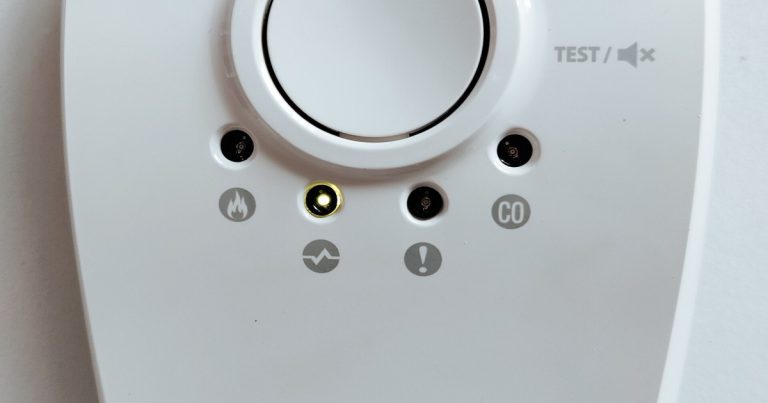
No, they are complementary devices. A smoke detector reacts to a fire starting; a CO2 monitor measures carbon dioxide, a gas that is always present and builds up when a room is poorly ventilated. A well-equipped home has both: our round-up of smart smoke detectors covers the reliable models.
Do air quality monitors use much power?
No. Mains-powered models (Netatmo, Qingping, TFA) draw 0.5 to 1.5 W, or less than €5 a year. Battery models last from three weeks (Ulanzi) to two years (Airthings). It is one of the most frugal smart-home categories — compare that with the 2-4 W of a camera or a hub.
Do these monitors need a subscription or a hub?
No subscription on any model in the test. On hubs: Netatmo, Qingping and Ulanzi work over direct Wi-Fi; the Eve Room needs a Thread hub (Apple TV, HomePod, Matter border router); Airthings and IKEA have their own gateway. Check this before buying — it is the first compatibility criterion.
Can the monitor detect mould?
Indirectly: no consumer monitor detects mould itself, but a reliable hygrometer flags the conditions that produce it — relative humidity above 65% on a cold surface. If humidity stays high despite ventilation, hunt the source (rising damp, thermal bridge, tumble dryer) before investing in a purifier.
Can a CO2 monitor save energy?
Yes, and it is an underrated angle. Heating stale air is pointless: by pairing the monitor with a smart thermostat, you can cut heating during night-time CO2 peaks and ventilate at the hours when the house warms up. The topic is covered in our guide to the best smart thermostats and in home energy monitoring.
Which monitor for a classroom or shared office?
A model with a screen and NDIR CO2: the TFA AirCO2NTROL is the proven benchmark (traffic light, alarm, no network required), while the Qingping Air Monitor Lite adds particles and Wi-Fi logging. Avoid screenless models: in a classroom, it is the visual indicator that makes people ventilate, not the app.
How do I know if my monitor is accurate?
Simple test: open every window for 10 minutes in dry weather — a reliable CO2 monitor should drop back towards 400-500 ppm, the outdoor concentration. If it still shows 700 or 900 ppm after ventilating, drift has set in: recalibrate it in fresh air (some models do this automatically) or contact the manufacturer.
Conclusion: our verdict on 2026 air quality monitors
Let us recap. 🏆 Best overall: Netatmo Smart Indoor Air Quality Monitor — the most balanced unit in the test, with the best app and zero subscription; it justifies its €99.99 as soon as you want serious tracking without tinkering. 🍎 Best for Apple/Matter: Eve Room — no cloud account, Thread, encrypted history. ☢️ Best multi-sensor: Airthings Wave Plus — the only one that measures radon, for concerned areas. 💰 Best budget: IKEA Vindstyrka at €39.99 for city particles. 🖥️ Best CO2 display: TFA AirCO2NTROL for classrooms and offices. ⚡ Best value for money: Qingping Air Monitor Lite — NDIR CO2 + PM2.5 + HomeKit for around €100; and for Matter homes, the Ulanzi TC001 at €85 brings indoor air into the ecosystem with no bridge.
Our overall advice: start by measuring CO2 and humidity in the bedroom and living room — that is where sleep, focus and mould risk are decided. Add particles if you live in a city, radon if you are in a granite area. Then wire it to your existing setup: a monitor that triggers a notification or an extractor fan is worth ten monitors displaying numbers in an app you no longer open. To complete your home’s protection, our guides to water leak detectors and smoke detectors cover the other two major household risks.
About the author: Alex Mercer is a technical writer specialising in smart home and air quality. He tests every monitor for several weeks, in his own home, before recommending it. See the author’s profile.
Last updated: September 2026. Methodology: 7 monitors (Netatmo Smart Indoor Air Quality Monitor, Eve Room Matter, Airthings Wave Plus, IKEA Vindstyrka, Qingping Air Monitor Lite CGDN1, TFA AirCO2NTROL, Ulanzi TC001) tested from 6 July to 16 August 2026 in a 72 m² apartment in Lyon, readings compared every 5 minutes against a reference NDIR analyser. Weighted criteria: reliability 30%, ecosystem 20%, app 15%, display 15%, price 10%, battery 10%. Sources: French decree n° 2022-1692 of 27 December 2022, WHO guidelines of 22 September 2021, ADEME, OQAI, Allen et al. 2016 (Environmental Health Perspectives), ANSES thresholds for schools, Matter 1.2 specification (CSA), EU regulation 2024/2847 (CRA).
* This article contains affiliate links. If you buy through these links, we may earn a commission at no extra cost to you. Our tests, measurements and rankings remain independent of any commercial partnership.