Best Smart Garage Door Controller 2026: Comparison and Buying Guide
The best smart garage door controller in 2026 is the SwitchBot Garage Door Opener (about €39): Matter-certified, wired door sensor included, no subscription. If you have three doors or an Apple Home setup, choose the Meross MSG200HK instead. But check your learn button first: a round white button means Security+ 3.0, and no third-party wired controller will work.
Affiliate disclosure: this article contains affiliate links. If you buy through them, we may earn a commission at no extra cost to you. Our testing and rankings remain independent and are never influenced by partners.
The garage door has become the most-used entrance in the house and, oddly, the one smart home has served worst. Bulbs and thermostats lined up behind Matter while the garage stayed a battlefield of closed APIs, proprietary protocols and — since late 2025 — a hardware lockdown that quietly made most tutorials obsolete. We reopened the file in October 2026: six controllers tested or documented, four different learn buttons, and a conclusion that starts with your existing hardware rather than with the fashionable product.
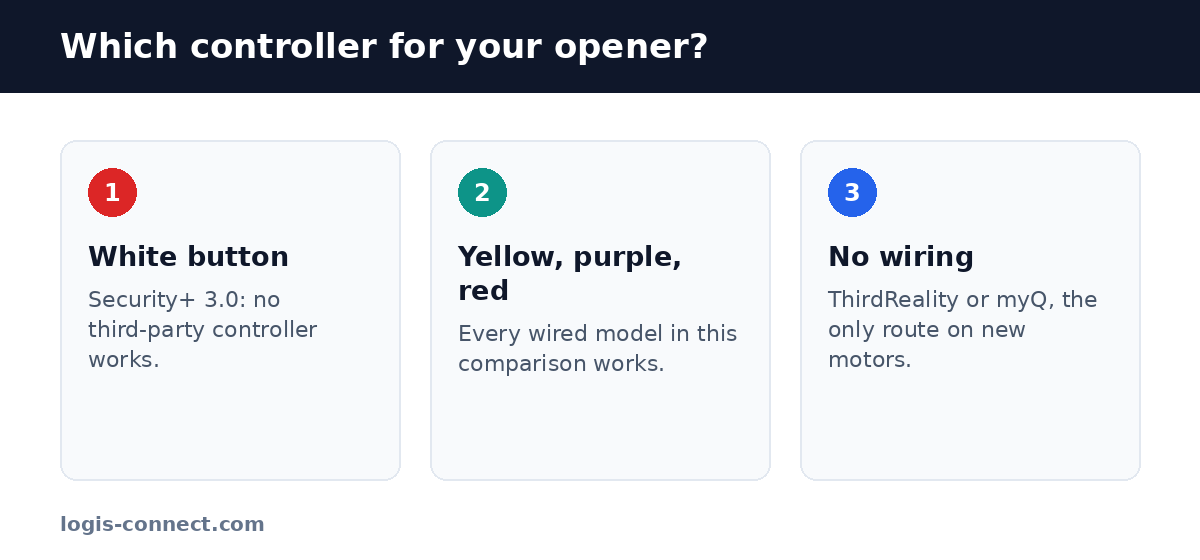
The short version. No third-party controller works on a Chamberlain/LiftMaster opener with a white learn button (Security+ 3.0, shipping since late 2025). On a yellow, purple, red or orange button, every model in this comparison works. The best all-round buy is the SwitchBot at around €39, Matter and subscription-free; the Meross MSG200HK remains the only one handling three doors with native HomeKit.
Why connect your garage door in 2026 (and what actually changes)
A connected garage door is not primarily a gadget. It solves three very concrete problems, and the third is the one nobody talks about.
- The door left open. This is the most common incident: you leave in the morning, the door stops halfway, nobody checks. A controller with a position sensor sends an alert and lets you close it remotely. On serious models, a scheduled 10 pm close is built in.
- Access without a key or a remote. Delivery driver, cleaner, neighbour, tradesperson: a temporary code or a shared app access replaces the remote that always ends up left in the car.
- Integration with the rest of the house. Close the door when the alarm arms, turn on the garage light when it opens, or check the state from a single app — this is where controller quality shows, and where cheap models fall over.
One number frames the decision: a controller costs €35 to €120, while replacing a complete opener costs €400 to €900 installed. The economics are simple — keep the motor, add the intelligence. The catch is that the motor has to agree to be driven.
The real 2026 blocker: your learn button
This is the point most comparisons bury in a footnote, and it is the only information that matters before you buy. Chamberlain (LiftMaster, Craftsman) introduced Security+ 3.0 on new openers from late 2025. The protocol drops the classic wired bus in favour of a Bluetooth link verified against the manufacturer’s servers. The consequence: controllers that wire into the motor terminals — Tailwind, Meross, ratgdo, Konnected — can no longer send a command.
The check is visual and takes ten seconds. Remove the light cover or the motor housing and look at the learn button:
| Learn button | Protocol | Compatible third-party controllers | What to do |
|---|---|---|---|
| White, round | Security+ 3.0 (2025-2026) | None of the wired models on the market | myQ only, or a controller that presses an existing remote (ThirdReality) |
| Yellow | Security+ 2.0 | SwitchBot, Meross, Tailwind, ratgdo, Konnected | Free choice, standard wired install |
| Purple | Security+ 2.0 (older) | All wired models | Check sensor cable length |
| Red / orange | Security+ 1.0 | All wired models | Sometimes needs a terminal adapter |
| Green / none | Third-party brand (Genie, Sommer, Marantec) | Model-dependent — Aladdin Connect for Genie | Check the maker’s compatibility list first |
If your motor is less than eighteen months old and has a white button, the decision is made for you: do not buy a wired controller. Two options remain — the manufacturer’s myQ app, with the limits detailed below, or a mechanical controller that physically presses an existing remote, such as the ThirdReality. It is less elegant, it works, and it is reversible.
2026 comparison: the six controllers worth your money
Prices checked in October 2026, excluding promotions and shipping. The subscription column covers what is charged for the basics — open, close, alerts, door state.
| Model | Typical price | Matter | HomeKit | Doors | Subscription | Our score |
|---|---|---|---|---|---|---|
| SwitchBot Garage Door Opener | ~€39 | Yes (Wi-Fi) | Via Matter | 1 | No | 9/10 |
| Meross MSG200HK | ~€90 | No | Native | 3 | No | 8.5/10 |
| Tailwind iQ3 2.0 | ~€85 (+€25 sensor) | No | Yes | 1 to 3 | No | 8/10 |
| ThirdReality Garage Opener | ~€50 | Yes | Via Matter | 1 | No | 7/10 |
| Genie Aladdin Connect | ~€60 | No | No | 1 to 3 | No | 6.5/10 |
| Konnected blaQ / ratgdo | ~€45 | Via hub | Via Home Assistant | 1 | No | 7.5/10 (HA) |
Two deliberate omissions: the myQ Smart Garage Hub, covered separately because its value depends entirely on your motor, and €15 modules with no door sensor, which cannot tell open from closed and turn any automation into a gamble.
Hands-on: model by model
SwitchBot Garage Door Opener: the default choice
The kit ships with the relay, a seven-metre wired magnetic sensor and the power adapter. Wiring goes to the wall-button terminals, and Matter pairing starts straight from the SwitchBot app with no extra hub. In practice it is the only model here that combines three rarely co-occurring qualities: a price under €40, genuinely certified Matter, and a position sensor in the box. The door shows up as a lock in Apple Home and Google Home — that is a quirk of the standard, not a product defect.
- Strengths: price, native Matter, wired sensor included, Bluetooth control without Wi-Fi, Bluetooth relay for other SwitchBot devices.
- Weaknesses: one door only, Siri can close but not open, Alexa requires a PIN, “lock” presentation in apps, sensor cable needs routing.
Meross MSG200HK: the three-door, Apple-first reference
The MSG200HK is not the most modern — no Matter — but it is still the only one driving three doors from a single box, with native HomeKit and an external Wi-Fi antenna that changes everything inside a concrete garage. Nine thousand Amazon reviews and a stable HomeKit integration make it the most predictable buy. For a double or triple garage it costs less than two SwitchBots and saves you a second app.
- Strengths: three doors, native HomeKit without a hub, external antenna, CarPlay, no subscription, mature ecosystem.
- Weaknesses: no Matter, the most traditional install here, wired sensor needs careful placement, purely utilitarian design.
Tailwind iQ3 2.0: opens as you arrive
It is the only model that opens the door before you touch anything: a Bluetooth link to your phone plus geofencing detects the car approaching. Night mode automatically closes the door if it opens between 11 pm and 6 am. Budget €25 more for the position sensor, which the auto-open depends on. Two caveats: it is incompatible with Security+ 3.0 like every wired unit, and documented cloud outages temporarily disable auto-open.
- Strengths: hands-free arrival, night mode, HomeKit, up to three doors, solid build.
- Weaknesses: price with sensor, cloud dependency for auto-open, one door per base unit.
ThirdReality Garage Door Opener: no wiring at all
The principle is entirely different: the module sits on an existing remote and physically presses the button, while a tilt sensor watches the door. No wire to touch, no risk of damaging the motor, and compatibility that ignores Security+ 3.0 because nothing connects to the bus. The trade-offs: the remote must stay powered, there is no audible warning before closing, and the module presents as a switch in Matter.
- Strengths: tool-free install, works with current openers, Matter, reversible and renter-friendly.
- Weaknesses: no pre-close warning, depends on a remote, no auto-open, coarser state tracking.
Genie Aladdin Connect: only if you already own a Genie
On a Genie opener, Aladdin Connect is the simplest option: the module connects to the motor and the app does the rest, with decent Alexa, Google and SmartThings support. Anywhere else it has no argument: no HomeKit, no Matter, a thinner app than Meross and a similar price.
- Strengths: native Genie integration, reasonable price, up to three doors, simple install.
- Weaknesses: limited ecosystem, no HomeKit or Matter, dated app.
Konnected blaQ and ratgdo: local control for Home Assistant
For a Home Assistant user, these two ESPHome boards beat everything else: they read the motor’s protocol and expose the real door state, the light, the lock and even the photo-eye status without any cloud. The ratgdo costs around €45 and wires up with three conductors. The limits are twofold: Security+ 2.0 only, and no Apple Home without going through Home Assistant.
- Strengths: fully local, real door state, open firmware, no account dependency.
- Weaknesses: technical audience, no native Matter, incompatible with Security+ 3.0, community support.
Matter and garages: where the standard really stands in 2026
It needs saying plainly, because product pages keep it vague: Matter 1.4 still defines no “garage door” device type. The Closures category meant to carry it is announced for a later release. Today’s Matter-certified controllers — SwitchBot, ThirdReality — work around it by declaring themselves as motorised covers or as locks. The result: open and close commands work everywhere, but the icon is wrong, position tracking is approximate, and some platforms restrict voice opening for safety reasons.
Is that a dealbreaker? No, as long as you know what you are buying. A mis-typed Matter device is still better than a non-Matter device for longevity: it needs no proprietary cloud to pair and keeps working when the maker shuts its app down. For more on the protocol’s limits, our guide to Matter connection problems covers the most common pairing failures.
myQ: what is free and what is not
The “myQ went paid” narrative is half wrong, and the nuance matters. Opening, closing, door state, notifications and scheduled closing stay free, with no time limit. What is charged is integrations and video. Since the API closed in November 2023, Home Assistant and HomeKit are no longer officially supported.
| Feature | Status | Price |
|---|---|---|
| Open / close / state / alerts | Free | €0 |
| Scheduled close, guest access | Free | €0 |
| Google Assistant, IFTTT | Paid (myQ Premium) | ~€1/month |
| In-car integration (Tesla, CarPlay) | Paid (Connected Services) | ~€45/year |
| Camera video history | Paid | €25 to €150/year |
Installation: 45 minutes, in the right order
The classic mistake is starting with the app. Do the reverse: hardware first, pairing second.
- Cut power to the motor at its dedicated breaker, not just with the remote. A garage motor is permanently live.
- Identify the two wall-button terminals (usually “wall” or “push button”). Those are what the relay bridges — never the power input.
- Mount the controller near the motor, sheltered from water spray, and route cables through existing trunking.
- Fit the door sensor at the top of the panel, aligned with the magnet on the frame, with a 10 to 20 mm gap. It determines how reliable the reported state is.
- Restore power, then pair in the app. Run three full cycles, including one stopping the door mid-travel to check obstruction detection.
- Set the automations: close at 10 pm, alert if the door stays open more than ten minutes, notification on every opening.
One non-negotiable safety point: never disable the motor’s photo-eyes to “simplify” the install. A controller adds a command, it does not replace the original safety devices. If your motor no longer detects obstructions, no controller will make it compliant — the motor is what needs fixing first.
Security: five settings to enable on day one
- Two-factor authentication on the manufacturer account. A connected garage is a remote front door.
- PIN code for voice opening, including Alexa where it is sometimes optional.
- Door-left-open alert beyond ten minutes, between 9 pm and 7 am.
- Named, time-limited guest access, revoked automatically after the expected visit.
- Opening log reviewed once a week — that is how you spot a lost remote or a forgotten access.
Which model for which profile?
- Best simplicity-to-price ratio: SwitchBot, ~€39. Matter, sensor included, fifteen-minute install.
- Two or three doors and an iPhone: Meross MSG200HK, ~€90. The only native HomeKit option covering three doors.
- You want it to open as you pull in: Tailwind iQ3 2.0, ~€110 with sensor.
- Your motor has a white button: ThirdReality, ~€50, or myQ. Nothing else will work.
- You run Home Assistant and want local control: ratgdo or Konnected blaQ, ~€45.
- You own a Genie: Aladdin Connect, ~€60.
The mistakes that cost real money
- Buying before checking the button. It is the leading cause of returns, and it is avoidable in ten seconds.
- Skipping the door sensor. Without it the controller believes the door closed after a pulse: automations become dangerous.
- Expecting Matter to do everything. The lock or cover typing still limits some functions, especially Siri opening.
- Ignoring Wi-Fi range. A detached reinforced-concrete garage needs an external antenna or an access point — exactly the Meross strength.
- Forgetting firmware updates. Security fixes ship through the app; a controller that is never updated is an unlocked door.
Methodology and sources
This comparison was built in October 2026 from three sources: official manuals and compatibility lists from the manufacturers (SwitchBot, Meross, Tailwind, Chamberlain), reviews published by Wirecutter, CNET and CNN Underscored between January and October 2026, and user reports on the Home Assistant forums and r/HomeKit. Prices are public European prices outside promotions and vary by 10 to 20% through the year. We excluded products without a position sensor and modules claiming Security+ 3.0 compatibility without verifiable proof. We will update this guide if Matter 1.5 introduces a dedicated garage door device type.
To complete the setup, our guides to Matter hubs, door and window sensors and alarm systems without a subscription follow on naturally. If your garage opens to the outside, our picks for smart outdoor lighting and Matter cameras cover the surveillance side.
FAQ: the questions we actually get
Can I connect any garage door?
Almost: a controller wires into the wall-button terminals on most motorised openers with a wired control, more than 1,600 models according to SwitchBot. The exceptions are white-button Security+ 3.0 motors, very old units with no accessible terminals, and doors with radio-only control and no wall button.
Do I need a subscription to open the door from my phone?
No, not for any model here. SwitchBot, Meross, Tailwind, ThirdReality, Genie and ratgdo charge €0 for opening, closing, state and alerts. myQ also keeps those basics free; only third-party integrations and video are paid.
Does the controller work during a power cut?
No. The controller has no battery and neither does the motor. During an outage you release the motor and open manually, as before. Some models include a backup battery for the electronics only, which keeps alerts running but not the motor.
Does Matter make the controller work with Apple Home?
Yes, through Apple’s Matter controller, but with the limits of the current typing: the door appears as a lock or a cover. Siri can close it, not always open it. If Siri opening matters, a native HomeKit model such as the Meross MSG200HK is more dependable.
Can one controller drive two doors?
Yes with the Meross MSG200HK (up to three doors) and Aladdin Connect depending on version. SwitchBot and ThirdReality are strictly single-channel: one kit per door. For a double garage the maths clearly favours Meross.
What is the difference between a controller and a smart opener?
A controller is an accessory added to an existing motor and costs €35 to €120. A smart opener is a complete motor unit with rail, belt and light, at €300 to €900 installed. If your motor works, the controller is almost always the right call.
Is the door sensor really necessary?
Yes, as soon as you want serious automation. Without it the controller sends a blind pulse: if the door was open it closes, if it was closed it opens. You cannot know the state, so you cannot safely schedule an evening close.
What happens if the controller loses Wi-Fi?
SwitchBot keeps Bluetooth control nearby, and ratgdo keeps working locally on the network. Other models go quiet until the network returns, but the remote and the wall button still work: no situation locks you out.
Do third-party controllers void the motor warranty?
Wiring into the low-voltage wall-button terminals does not affect the warranty in most cases, though some manufacturers may argue otherwise. ThirdReality, which makes no electrical connection to the motor, removes the risk entirely. When in doubt, keep the original remote and photograph the wiring before you start.
Should I worry about garage door hacking?
The real risk is low but not zero: it mostly involves reused passwords and accounts without two-factor authentication. Enable 2FA, use a unique password, revoke expired guest access and keep firmware current. None of the publicly documented 2025-2026 incidents relied on attacking the protocol itself.