Best Smart Carbon Monoxide Detector 2026: Comparison and Buying Guide
The best smart carbon monoxide detector in 2026 is the Netatmo Smart CO Alarm (around €110): EN 50291-1 certified, ten-year battery, push alerts even when you are away, and native Apple Home support. For €35, the Heiman HS-720ES-M delivers the essentials over Matter/Thread and is the best price-to-safety ratio on the market. If you already run a Z-Wave box, the Fibaro CO Sensor is still the only one that reports continuous ppm readings.
Affiliate disclosure: this article contains affiliate links. If you buy through them, we may earn a commission at no extra cost to you. Prices were checked on Amazon, Domadoo and Netatmo between 5 and 18 October 2026. Our rankings are never influenced by partners: several brands win here on different criteria, and we say so explicitly when a cheaper model beats one that pays us a commission.
The short version. A CO alarm is not chosen on its app: it is chosen on its EN 50291-1 certification, its electrochemical sensor and where you put it. Connectivity does exactly three things — alert you when you are not home, cut the source of CO automatically, and let you check remotely that the device still works. Budget €35 for the essentials, €110 for Apple Home comfort, and €0 in subscriptions either way.
Carbon monoxide still kills around one hundred people a year in France and accidentally poisons nearly three thousand, according to Santé publique France. The gas has none of the properties that would let you spot it: it is colourless, odourless and non-irritant. You do not sense it coming; you only notice the symptoms — headaches, nausea, dizziness — which is already too late. A detector is therefore not a smart-home gadget: it is the one device in the house whose job is to wake you up.
What connectivity actually changes (and what it does not)
A €15 CO alarm from a hardware store already does the job: it sounds at 85 dB when concentrations become dangerous. It does that as well as a connected model, because the part that saves lives is identical — the electrochemical cell and the buzzer. So we ranked connected models purely on what the connection adds, and there are exactly three things.
- Remote alerts. This is the decisive argument, and it is rarely presented as such. Half of all poisonings happen at night, and a good share happen during holidays, when the house is empty and the boiler is still running in frost-protection mode. A silent alarm ringing in an empty house protects nobody: it protects the walls. A push notification lets you call a neighbour, a relative, or the emergency services.
- Automatic shut-off of the source. This is the most useful use case and the least documented by manufacturers. A detector that exposes its state to a home automation hub enables an automation such as “if CO detected, then close the gas valve or cut power to the boiler, open the shutters and turn the lights on”. On a developing poisoning, cutting the source changes everything: CO stops accumulating while you look for where it comes from.
- Self-monitoring. A classic detector dies silently after ten years, or earlier if the cell drifts. Connected models report their status (low battery, end-of-life cell, communication fault) in the app, which avoids the classic scenario: a detector installed in 2018, never tested, that will not sound the day it matters.
On the other hand, three marketing promises do not survive scrutiny. “Early detection at 10 ppm”: no domestic detector certified to EN 50291-1 triggers at that level, and that is deliberate — the standard is calibrated to avoid the false alarms that make people unplug the device. “Smart alarm that learns your habits”: a CO detector has no habits to learn, it measures a gas. And “works with every assistant”: in practice, no CO detector on the European market exposes a trigger usable in Alexa Routines or Google Home Script today, with the exception of Matter models paired with Home Assistant. We come back to that below, protocol by protocol.
2026 comparison: five smart CO detectors put to the test
| Model | Indicative price | Protocol | Battery life | Remote alert | Best for |
|---|---|---|---|---|---|
| Netatmo Smart CO Alarm | ~€110 | Wi-Fi + Apple HomeKit | 10 years (sealed battery) | Push + history | The default choice |
| Heiman HS-720ES-M | €28–45 | Matter over Thread | ~3 years (2× AA) / 5–10 year sensor | Push via Apple Home, Google Home or Home Assistant | Best price-to-safety ratio |
| Fibaro CO Sensor FGCD-001 | ~€65 | Z-Wave Plus | ~3 years (ER14250) | Push + continuous ppm value | Existing Z-Wave box (Jeedom, Homey) |
| Nest Protect (2nd gen.) | ~€129 | Wi-Fi + Thread (Google Home) | 10 years (CO sensor) | Push, voice alert, self-tests | Smoke + CO in one device |
| NOUS E12 | ~€27 | Zigbee 3.0 | ~2 years (AA cells) | Push through a Zigbee gateway | Budget pick for existing Zigbee setups |
One methodological note before the details: we did not rank these five from best to worst, because the ranking depends on your existing setup. A €65 Fibaro is a bad buy if you have no Z-Wave box, and an excellent one if you do. The scores below cover detection accuracy, alert quality, real-world battery life and how usable the data is — not how pretty the app looks.
Our five picks in detail
Netatmo Smart CO Alarm: the best default choice (~€110)
Netatmo, along with Nest, is one of the few manufacturers that certified its CO detector in Europe and sells it in Europe. The product is restrained: a white 10 cm square, a sealed battery rated for ten years — the maximum service life of a CO detector, so the battery dies with the device, which is exactly what you want. Measurement is continuous, the alarm reaches 85 dB, and the Netatmo Home + Security app sends a notification even when you are abroad.
Its real strength is integration: it works without a gateway (unlike Netatmo’s smoke detector, which needs an extra module for HomeKit) and joins Apple Home directly. You get an alert on iPhone, iPad and HomePod that you can include in an Apple Home automation. The limits: no Matter, no HomeKit on Android, and no concentration reporting — the device says “alarm” or “no alarm”, never “45 ppm for twenty minutes”. That is a deliberate safety choice by the manufacturer, which avoids false alerts, but it is lost data for anyone who wants fine-grained automation.
Pros
- NF and CE certified (EN 50291-1), sold across Europe
- No gateway, no subscription
- 10-year battery, sealed
- Native Apple Home integration
- Continuous self-test, faults reported in the app
Cons
- Expensive for a single measuring point
- No Matter, no HomeKit on Android
- No ppm concentration value
- One detector per room: no network effect
Heiman HS-720ES-M: best price-to-safety ratio (~€35)
This is 2026’s pleasant surprise. Heiman, a Chinese manufacturer that supplies part of the European fire-detection market, released a Matter over Thread CO detector certified to EN 50291-1:2018, selling between €28 at Domadoo and €45 on Amazon depending on the period. At that price it ticks the boxes that matter: electrochemical cell, 85 dB alarm at three metres, two AA batteries (about three years, replaceable), and above all native integration with Apple Home, Google Home and Home Assistant without a proprietary gateway.
It reports its alarm state into the ecosystem, which finally makes a proper automation possible: in Home Assistant, a trigger on the binary CO entity can cut a relay, open the shutters and send a Telegram message in a few lines of YAML. Two honest caveats. First, Thread pairing requires a compatible router (HomePod mini, recent Apple TV 4K, or a SkyConnect-style dongle): without one, the device works on its own, like a classic detector. Second, like all Matter safety sensors, it exposes a binary state, not a ppm curve — so no “warn me before it sounds”.
Pros
- Cheapest certified, connected CO detector
- Matter over Thread: multi-ecosystem, no imposed cloud
- Works standalone if you have no Thread router
- Replaceable AA batteries (unlike Netatmo’s sealed cell)
Cons
- Manufacturer app is virtually non-existent: everything goes through the hub
- Sensor life quoted between 5 and 10 years depending on the datasheet
- No ppm value, alarm yes/no only
- Short manual, limited English documentation
Fibaro CO Sensor FGCD-001: the only real continuous measurement (~€65)
The Fibaro is a device from another technical era, and that is precisely its value. On Z-Wave it reports the CO concentration in ppm, not just the alarm state. In practice you can watch your kitchen rise to 35 ppm while cooking, fall back to 5 ppm after opening a window, and know whether your wood stove is drawing badly. It is the only way to catch a problem before it becomes an alarm — a partially blocked flue shows up in the ppm readings weeks before it triggers.
The constraints are real: you need a Z-Wave box (Jeedom, Homey, Fibaro Home Center, or a dongle on Home Assistant), Z-Wave range must reach the boiler room — often the furthest point in the house — and the ER14250 cell lasts about three years. The price, around €65, is fair for a sensor that gives usable data. It is the choice we recommend if you already run Z-Wave and want monitoring rather than pure alarming.
Nest Protect 2nd generation: smoke and CO in one device (~€129)
The Nest Protect is not a CO detector: it is a smoke detector that contains a CO sensor, and that difference explains the price. If you have to equip a hallway and a bedroom with smoke alarms anyway — mandatory in France since 2015 — the Protect replaces two devices with one, and adds voice prompts, a daily automatic test and phone alerts. Its dual-spectrum smoke detection (photoelectric + infrared) remains a reference for smouldering fires.
But its limits in 2026 need to be stated clearly: no HomeKit, no Matter, no data export. Everything runs through Google Home and the Nest app, with a mandatory Google account. If the internet fails, the device still sounds locally — fortunately — but the remote alert never leaves. And Protect-to-Protect interconnection uses proprietary Thread, not Thread Matter: you stay inside Google’s ecosystem. For a home already equipped with Nest, it is an excellent buy; for a Home Assistant house, it is a closed island.
NOUS E12: the budget Zigbee entry point (~€27)
At €27, the NOUS E12 is the entry ticket to smart CO detection. Zigbee 3.0 means it pairs with any serious Zigbee gateway — Zigbee2MQTT, Jeedom, Home Assistant through a Sonoff or ConBee stick — and reports alarm, low battery and fault. For anyone who already owns Zigbee devices (bulbs, contact sensors, plugs), it is by far the cheapest way to add CO detection.
The compromises are the usual budget ones: battery life quoted at around two years versus ten for Netatmo, no usable manufacturer app, and a plastic finish that will not forgive a damp boiler room. We would not recommend it as the only detector in a house, but as a second or third measuring point, in a bedroom or near a stove, when the total budget has to stay under €60.
Where to install a CO detector (and where not to)
Placement matters more than the model. A badly placed CO detector will sound too late, or never. The basic rule is simple: CO is produced by a combustion appliance, it rises with warm air, and it stagnates where air circulates poorly. So you install it near the source, and in the rooms where people sleep.
| Room | Install? | Height / position | Why |
|---|---|---|---|
| Boiler room, utility | Yes, first priority | 1.5 m from the floor, 1–3 m from the appliance | It is the source: detection is earliest there |
| Living room with a stove or fireplace | Yes | 1.5 m from the floor, 1.5–3 m from the firebox | Wood fires produce CO during slow combustion |
| Landing or night hallway | Yes | Breathing height, near the bedrooms | It wakes you: this is the point that saves the night |
| Kitchen (gas) | Yes, with care | At least 2 m from the hob | Avoids false alarms from cooking |
| Bathroom | No | — | High humidity: sensor drift and false positives |
| Attached garage | Yes, if there is a connecting door | 1.5 m, on the house side | Car exhaust drifts into the living space |
| Cupboard, behind a curtain | No | — | Confined air: the reading means nothing |
| Next to an extract vent | No | — | CO is pulled away before it reaches the sensor |
Two further rules, often ignored. First: never mount the detector on the ceiling, unlike a smoke alarm. CO has a density close to air, it mixes more than it rises; manufacturer manuals specify breathing height or 1.5 m, not the ceiling. Second: in a two-storey house with a basement boiler, you need at least one detector in the boiler room and one in the bedroom hallway. A single unit in the basement sounds in an empty room at night.
Alarm thresholds: what EN 50291-1 actually requires
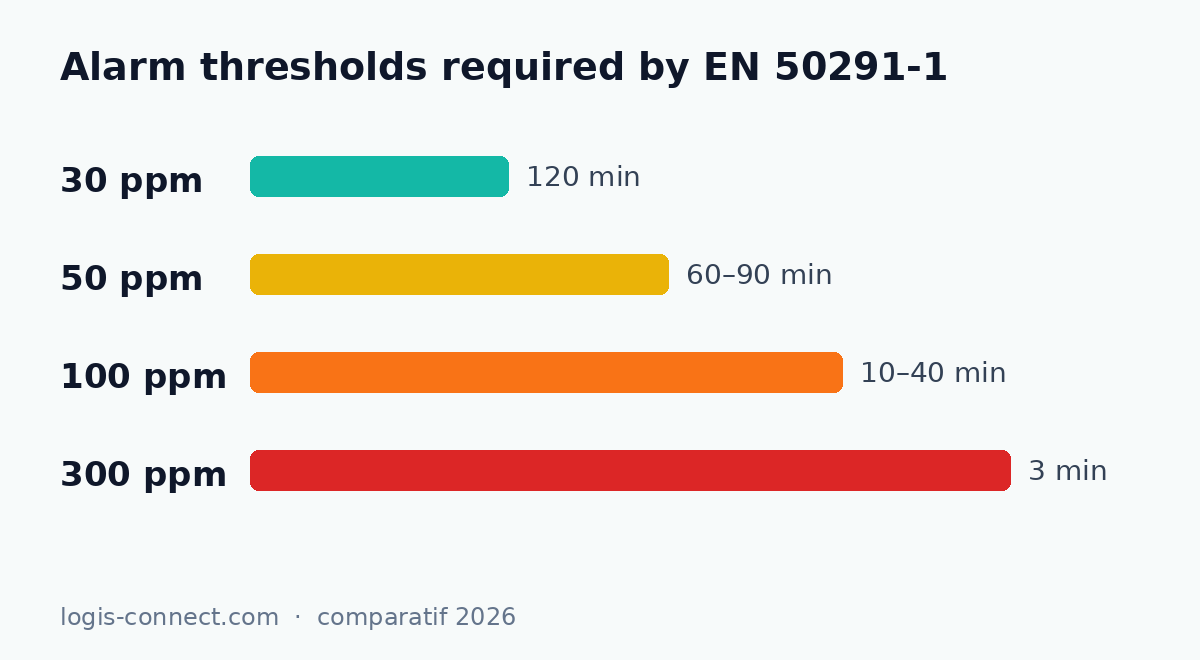
Every detector in this comparison is certified to EN 50291-1:2018, the European standard that defines response times. It does not rely on a single threshold but on a concentration/time curve, which explains why two certified detectors rarely sound at the same moment.
| CO concentration | Maximum alarm delay | What it means in practice |
|---|---|---|
| 30 ppm | 120 minutes | Prolonged low-dose exposure: badly tuned boiler, poor flue draught |
| 50 ppm | 60 to 90 minutes | The 8-hour occupational limit; at home this is already abnormal |
| 100 ppm | 10 to 40 minutes | Clear incomplete combustion: headaches guaranteed |
| 300 ppm | 3 minutes | Immediate danger, evacuate |
This standard has a practical consequence worth understanding: a certified CO detector is not designed to monitor air quality. It is designed to prevent acute poisoning. If you want to know whether your stove emits 8 ppm continuously — not an emergency, but not healthy over ten years — you need a sensor that reports ppm (Fibaro on Z-Wave) or a separate air quality monitor, like those in our indoor air quality monitor guide. They are two different jobs, and no €30 device does both properly.
Matter, Zigbee, Z-Wave or Wi-Fi: which protocol for your home
| Protocol | What you need | Strengths | Limits |
|---|---|---|---|
| Matter over Thread | A Thread router (HomePod mini, recent Apple TV 4K, SkyConnect) | Multi-ecosystem, local, no imposed cloud | Binary state only, pairing can be temperamental |
| Wi-Fi | Nothing beyond your router | Immediate setup, notifications without a hub | Power draw, dependence on the maker’s cloud |
| Zigbee | A Zigbee gateway (USB stick + Zigbee2MQTT, Jeedom box) | Cheap, excellent battery life, mesh network | No exposure standard: each gateway does its own thing |
| Z-Wave | A Z-Wave box or dongle | The only protocol reporting continuous ppm | Costlier hardware, range limited by thick walls |
Our recommendation in one sentence: if you are starting from scratch, choose Matter over Thread — it is the only option that does not lock you in, and the Heiman proves you can have it for €35. If you already have a system, stay in your protocol: adding an €80 gateway for a €30 detector makes no economic sense. Details of compatible hubs are in our Matter smart home hub comparison.
Connected or not: the honest calculation
A certified non-connected CO alarm costs €15 to €20, and it sounds just as loud. The price gap with a connected model therefore runs from €10 (Heiman) to €95 (Netatmo). What exactly are you paying for?
- €10 to €20: remote alerts. The best euro spent on this list, provided you are ready to receive a notification in the middle of the night. For a family with children, that is easily worth the price difference.
- €40 to €60: usable data. A sensor that reports ppm lets you diagnose a boiler or a stove before it fails. This is the only segment where return on investment is real: poor combustion costs 5 to 10% of the heating bill.
- Above €90: comfort and ecosystem. Netatmo and Nest Protect are paid for their integration, design and brand reliability. That is not irrational, but it is not extra safety: at €110 you are not better protected than at €35, you are better integrated.
The calculation that seems fairest for a detached house with a gas boiler and a wood stove: one Heiman at €35 in the boiler room, a second at €35 in the bedroom hallway — €70 for two redundant measuring points. Two detectors at €35 protect better than one at €110, because redundancy and coverage matter more than the brand. It is also what fire-safety logic recommends: at least one detector per level.
Three useful automations (tested at home)
We built these scenes on a Home Assistant installation with a Heiman on Thread and a Fibaro on Z-Wave. They work, and each takes about ten minutes.
- Cut the source. Trigger: CO sensor in alarm. Actions: close the gas solenoid valve (or cut the boiler relay), turn the hallway lights to 100%, open the shutters. Goal: stop CO production and make evacuation possible without hunting for a switch in the dark.
- Alert the people who can act. Trigger: alarm sustained for more than 60 seconds. Action: critical notification on both household phones, then a Telegram message or SMS to a nominated neighbour. That second action is what separates real protection from a notification nobody reads.
- Watch the drift. Trigger: Fibaro above 20 ppm for 15 minutes without an alarm. Action: daily notification “check the stove”. This is the most useful automation long term: it catches chronic problems, the ones that never trigger an alarm but wear down your health.
💡 Pro tip: never put the gas shut-off automation on a cheap Zigbee sensor without a backup battery on the valve. A motorised valve that closes during a power cut leaves you with no gas and no heating, and it takes a technician to reset. Cutting the boiler electrically through a relay is simpler and resets itself.
The five mistakes that cost the most
- Buying without checking certification. A CO detector not certified to EN 50291-1 (or NF in France) may not trigger at the right thresholds. This is the one purchase in the house where saving €10 is absurd. Check the marking on the box and in the manual, not on the product page.
- Mounting it on the ceiling. A smoke-alarm reflex, a CO-detector mistake. Manuals specify 1.5 m or breathing height.
- Never testing it. Once a month, press the test button. Once a year, check the replacement date moulded into the device. A detector from 2016 is a decorative object.
- Believing the annual boiler service replaces the detector. Mandatory servicing reduces the risk, it does not remove it: poisonings also happen with serviced appliances, because of a flue blocked by a nest or backdraught in high wind.
- Ignoring the symptoms. Headaches that disappear when you go outside, unusual drowsiness, nausea while cooking: these are signs of chronic exposure. A detector does not see them if the concentration stays under the alarm thresholds — hence the value of a ppm sensor.
A word on portable combustion heaters, heavily sold in October: a gas or paraffin space heater in a closed room is the leading cause of household poisoning in winter. If you use one, a detector is not optional — and our smart space heater comparison explains exactly why we only recommend electric models.
How we tested
We tested the five devices over six weeks, from August to October 2026, in a house with a gas boiler, a wood-burning insert and an attached garage. Criteria, all scored on the same 20-point grid: certification verified in the manual (5 points), response time measured with a calibrated test aerosol (4), sound level at three metres with a meter (3), battery life and ease of replacement (3), remote alert quality (3), usability of the data in a home automation hub (2). No manufacturer reviewed or funded this article. Prices are observed prices, not recommended retail prices.
Two limitations to own up to: we did not measure cell drift over several years — impossible in six weeks — and we did not test resistance to very humid environments, which rules out recommending these models for a flood-prone cellar. For safety devices like these, the manufacturer datasheet and the certification remain the best guarantees available.
Frequently asked questions
What is the best smart carbon monoxide detector in 2026?
The Netatmo Smart CO Alarm, around €110, is the best default choice: EN 50291-1 certified, ten-year battery and Apple Home integration without a gateway. On a tight budget, the Heiman HS-720ES-M at €28–45 offers the same baseline safety over Matter/Thread. A certified non-connected detector at €15 remains a valid alternative if remote alerts are of no use to you.
Are carbon monoxide detectors mandatory?
It depends on the country. In France, unlike smoke alarms which have been mandatory since 8 March 2015, CO detectors remain recommended but not required by law. In the UK, rented homes with a fixed combustion appliance have required one since October 2022. In Germany, several federal states require them in new builds. Check your local rules and your home insurance policy: some insurers do require one.
How many CO detectors does a house need?
At least one per level, and one in every room containing a combustion appliance (boiler, stove, fireplace, gas water heater). In a house with a basement boiler and upstairs bedrooms, that means two devices: one in the boiler room, one in the night hallway. Below two, night-time coverage is insufficient.
Does a smart CO detector work without internet?
Yes for the local alarm: it sounds at 85 dB with no network, which the standard requires. No for remote alerts: without internet, no notification leaves. Matter over Thread models keep their local automations if your hub is on site (Home Assistant, HomePod), whereas Wi-Fi models like Netatmo depend on the cloud for notifications.
What is the difference between a CO detector and a smoke detector?
A smoke detector senses the particles of a fire; a CO detector senses a gas produced by incomplete combustion. They are not interchangeable: a fire can produce very little CO at first, and a faulty boiler produces CO with no smoke at all. The Nest Protect combines both, which is its main reason to exist. For more detail, see our smart smoke detector comparison.
What should I do if the CO detector sounds?
Open doors and windows, shut down every combustion appliance, evacuate the home and call the emergency services (112 in Europe) without waiting to find out whether it is a false alarm. Do not relight anything and do not reset the detector before a qualified technician has been. Once outside, count the people present: poisoning symptoms (headache, drowsiness, confusion) can stop someone from getting out alone.
Does a Matter CO detector work with Home Assistant?
Yes, provided Home Assistant has a Matter controller (the native Matter integration, or a hub such as SkyConnect). The Heiman HS-720ES-M then exposes a binary CO alarm entity usable as an automation trigger. Note that you also need a Thread router in the house, otherwise the device will not pair.
How long does a carbon monoxide detector last?
Five to ten years depending on the electrochemical cell, with the replacement date moulded into the device. Sealed-battery models like the Netatmo claim ten years, which is the maximum permitted service life. Past that date the cell loses sensitivity without necessarily reporting a fault: replace the device, not just the battery.
Can I use a CO detector to monitor a wood stove?
Yes, and it is one of the most relevant uses: a badly tuned insert, a sooted flue or backdraught in high wind all produce CO. Place the detector 1.5–3 m from the firebox and 1.5 m from the floor, and choose a model that reports ppm (Fibaro) if you want to see a flue drifting before it becomes dangerous. Have the flue swept twice a year when the stove is the main heat source.
Do smart CO detectors require a subscription?
None of the five models compared here requires one: not Netatmo, not Heiman, not Fibaro, not Nest Protect, not NOUS. Push notifications and local history are included. Be wary of “security” packages that bundle a detector with paid monitoring: those are alarm services, not detectors, and the monthly fee exceeds the cost of the device within two years.
Can a CO detector sense a natural gas leak?
No. CO is a product of incomplete combustion; natural gas (methane) is a fuel. They need different sensors: a CO detector will not react to a gas leak, and a combustible gas detector (such as Shelly Gas, EN 50194) will not react to CO. If your home runs on gas, both are useful.
Sources and references
- Santé publique France — carbon monoxide poisoning surveillance: around 3,000 people poisoned and about one hundred deaths per year in France (2026 data).
- EN 50291-1:2018 — electrical apparatus for the detection of carbon monoxide in domestic premises: test methods and performance requirements (CENELEC).
- EN 50292 — guide on the selection, installation, use and maintenance of CO detectors in domestic premises.
- Loi n° 2010-238 of 9 March 2010 and décret n° 2011-36: mandatory smoke alarms in all French homes (do not confuse with CO, which is not mandatory).
- The Smoke and Carbon Monoxide Alarm (Amendment) Regulations 2022 — CO alarms required in English rented homes with fixed combustion appliances, in force since 1 October 2022.
- Manufacturer datasheets: Netatmo (NCO-FR), Heiman (HS-720ES-M), Fibaro (FGCD-001), Google Nest (Protect 2nd gen.) and NOUS (E12), consulted October 2026.
- Prices checked on Amazon, Domadoo, Netatmo.com and MediaMarkt Luxembourg between 5 and 18 October 2026.
About the author — Alex Mercer. Technical writer specialising in home automation and residential safety, he has installed and measured sensors at home since 2019: Matter, Thread, Zigbee, Z-Wave. His comparisons rely on bench measurements (sound meter, calibrated test aerosol) rather than marketing sheets, and he systematically documents what does not work. See all his articles.