Best Smart Space Heater 2026: Comparison and Buying Guide
The best smart space heater in 2026 is the Philips 3000 Connected (around €70): 2,000 W, a thermostat adjustable to the degree from 1 to 37 °C, app-based scheduling, and a price that does not double just because there is a Wi-Fi chip inside. For a bedroom where silence matters, choose the Mill 1200 W (around €170). For a home office, the Dreo Atom 316S at under €60 is more than enough.
Affiliate disclosure: this article contains affiliate links. If you buy through them, we may earn a commission at no extra cost to you. Prices quoted were checked between 25 September and 18 October 2026. Our rankings are never influenced by partners: several brands win here on different criteria.
A smart space heater does not heat better than a conventional one. It heats at the right time, in the right room, and stops when the room is empty. That is where the money is: on an electric resistance, 1 kWh consumed produces 1 kWh of heat, whatever the price of the appliance or the number of sensors inside it. So we ranked seven connected models on what actually changes the bill — thermostat accuracy, scheduling and measurable consumption — then calculated what one hour of operation costs at every power rating on the market, at the regulated electricity tariff currently in force.
The short version. Connectivity never cuts consumption at equal power: it stops you heating an empty room. The best price-to-features ratio is the Philips 3000 Connected at ~€70, provided you accept a fan heater (and therefore some noise). The only criterion that genuinely lowers the bill is an accurate electronic thermostat, not the heating technology. And no space heater on the French market is Matter-certified as of October 2026: rely on the manufacturer’s app, or on a smart plug for automation.
What connectivity really changes (and what it does not)
Product pages promise “up to 30% savings”. The promise is not false, but it is badly framed: the saving never comes from the heating technology, it comes from removing unnecessary heating hours. A 2,000 W appliance draws 2 kWh per hour, connected or not. What connectivity actually delivers comes down to three things.
- Pre-heating from a distance. You switch the bedroom or office on twenty minutes before arriving, from the train or the car. In a poorly insulated flat, this is the only use that truly justifies the extra cost: the room is warm when you walk in, without running all day.
- Consumption tracking. Serious models (Mill, Philips 5000, Dreo) show kWh used per day and per week. It is the only way to know whether the heater costs €15 or €60 a month — and therefore whether you need to use it differently.
- Scenes and automation. “If nobody is home, turn the heater off”, “if the living room drops below 18 °C and it is 7 am, run it for 30 minutes”. That requires a smart home system able to talk to the appliance, which is not guaranteed: see the Matter question below.
Conversely, three marketing arguments do not survive scrutiny. The “smart heater that learns your habits” almost always amounts to a weekly schedule in the app that you could have set in five minutes. “Eco mode” is nothing more than reduced power or a lowered setpoint. And “gentle heat” (ceramic, infrared, graphene) does not change efficiency: it changes perceived comfort and noise, which is already a lot, but it is not a saving.
2026 comparison: the seven best smart space heaters
| Model | Type | Power | Control | Indicative price | Best for |
|---|---|---|---|---|---|
| Philips 3000 Connected | Ceramic fan heater | 2,000 W (900 / 1,200 / 2,000) | Wi-Fi, app, thermostat 1–37 °C | ~€70 | The default choice |
| Mill 1200 W Wi-Fi | Natural convection panel | 1,200 W | Wi-Fi, Mill app, consumption tracking | ~€170 | Bedroom and office, total silence |
| Dreo Atom 316S | Ceramic PTC fan heater | 1,500 W (3 levels) | Wi-Fi, app, 5–35 °C | ~€60 | Small office, remote work |
| Adax VP12 H | Wall-mounted convector | 2,500 W | Bluetooth, thermostat 0.5 °C | ~€210 | Large, poorly insulated room |
| Dreo tower 2,000 W | Oscillating ceramic tower | 2,000 W (3 levels) | Wi-Fi, app, 12 h timer | ~€95 | Open-plan living room |
| Philips 5000 Connected | Ceramic fan heater | 2,000 W | Wi-Fi, Alexa / Google, Home+ Control app | ~€200 | Large room, voice control |
| Dyson Purifier Hot+Cool | Fan heater + purifier | Not published by the manufacturer | Wi-Fi, MyDyson app, remote | ~€499 | Dual use: heat plus filtration |
One eighth appliance deserves mention as a benchmark: the De’Longhi Radia S 1,500 W (oil-filled, ~€68) is not connected, but it remains the reference for silent comfort at a low price. If you need neither remote control nor consumption tracking, it does the job as well as the connected models on this list — and that is exactly the question to ask before buying.
Our four favourites in detail
Philips 3000 Connected: the default choice (~€70)
This is the model that breaks the market: 2,000 W across three levels, an electronic thermostat adjustable to the degree from 1 to 37 °C, slot-based scheduling in the app, and a street price under €70. At that price you are no longer paying a premium for connectivity: it is included in the cost of a decent fan heater. Warm-up is fast (ceramic element), the unit cuts out at the setpoint and restarts on its own when the temperature drops, which is exactly the behaviour you want from a supplementary heater.
Pros
- Thermostat 1–37 °C, accurate to the degree
- Scheduling that is genuinely usable
- Unbeatable price for a connected unit
- Three power levels: 900 W is enough for an office
Cons
- Fan heater: continuous airflow noise
- Proprietary app, no Matter
- Heats fast but stops as soon as power is cut
- No detailed consumption tracking
Mill 1200 W Wi-Fi: silence for the bedroom (~€170)
The Mill is a Norwegian natural-convection panel: no fan, therefore no noise, and an outer surface that stays below 60 °C, which changes everything with children or a cat around. The app tracks actual consumption and schedules the week. On the other hand, 1,200 W tops out at 12–17 m²: this is a bedroom or office appliance, not a living-room heater. The price, two and a half times the Philips, buys finish and silence, not energy performance.
Pros
- Completely silent, no moving parts
- Consumption tracking in the app
- Outer surface below 60 °C
- A design that does not look like a space heater
Cons
- 1,200 W only
- Slow warm-up (natural convection)
- High price per installed watt
- No Matter compatibility
Dreo Atom 316S: the best small budget (~€60)
A 24.5 cm column, 1.38 kg, built-in handle: it moves from room to room in one hand. 1,500 W of PTC ceramic, a thermostat from 5 to 35 °C, the Dreo app, and 34 dB claimed — in practice, a continuous but discreet airflow. This is the unit you switch on under the desk at 7 am and turn off when you leave the room. Its limit is physical: 1,500 W will not heat a 30 m² living room, whatever the setting.
Pros
- Very low price, connectivity included
- Heats within seconds
- Very compact and light
- Thermostat accurate to the degree
Cons
- 1,500 W: small rooms only
- Airflow audible when heating
- No remote control in the box
- Cloud app, no local integration
Adax VP12 H: power for difficult rooms (~€210)
2,500 W, a thermostat adjustable in 0.5 °C steps, optional wall mounting: this is the choice for poorly insulated rooms, extensions and conservatories, where 1,500 W is simply not enough. Watch out for a detail that comparisons often miss: control is over Bluetooth, not Wi-Fi. You can schedule from your phone at home, but you cannot switch the unit on remotely from outside. If remote pre-heating is your main need, this is not the right model.
What does one hour of space heating actually cost?
The maths is simple and has no surprises: power (kW) × price per kWh. At the regulated tariff, base option, of €0.2001 per kWh including tax (rate in force since 1 August 2026), here is what each appliance costs at full power.
| Appliance | Power | Cost / hour | 4 h/day over 90 days | Per month (4 h/day) |
|---|---|---|---|---|
| Dreo Atom 316S | 1,500 W | €0.30 | €108 | €36 |
| Mill 1200 W | 1,200 W | €0.24 | €86 | €29 |
| Philips 3000 / Dreo tower | 2,000 W | €0.40 | €144 | €48 |
| Adax VP12 H | 2,500 W | €0.50 | €180 | €60 |
| 1,000 W convector (benchmark) | 1,000 W | €0.20 | €72 | €24 |
The table says it all: electric space heating is expensive, and the only real lever is reducing the hours of operation. A 2,000 W unit used 4 hours a day for three months costs €144 — more than the price of the appliance itself. That is why scheduling and automatic shut-off matter more than any technological argument.
How much power for which room?
The commonly accepted rule for electric space heating is 70 to 100 W per m² in a correctly insulated room, and more above 2.5 m ceiling height or if the walls are uninsulated. It is an estimate, not a thermal calculation: only a heat-loss survey gives a reliable figure.
| Room | Area | Recommended power | Suitable model |
|---|---|---|---|
| Office, spare bedroom | 8–12 m² | 1,000–1,200 W | Mill 1200 W, Philips 3000 at 900 W |
| Main bedroom | 12–17 m² | 1,200–1,500 W | Mill 1200 W, Dreo Atom 316S |
| Living room | 20–25 m² | 2,000 W | Philips 3000, Dreo tower |
| Poorly insulated room, conservatory | 20–25 m² | 2,500 W | Adax VP12 H |
| Bathroom | 4–6 m² | 1,000–2,000 W, IPX4 | Bathroom fan heater, outside zone 2 |
Safety: five non-negotiable rules
- Never on a power strip. A 2,000 W appliance draws close to 9 A continuously: plug it straight into the wall, into a socket in good condition, never through a coiled extension lead. This is the leading cause of house fires linked to this type of appliance.
- One metre of clearance. Curtains, laundry, sofa, Christmas tree: anything that can touch the grille must stay away. Serious models have tip-over protection and overheat cut-off; that is no reason to push them against furniture.
- Outside zone 2 in the bathroom. A portable appliance must stay more than 60 cm from the bath or shower. For use inside the room, choose an IPX4 model and read the manual: the “bathroom” label is not decorative.
- No space heater overnight in a child’s room without supervision, and never a combustion appliance (gas, paraffin) in a closed room. Carbon monoxide poisoning still causes nearly 3,000 hospital admissions and around a hundred deaths a year in France.
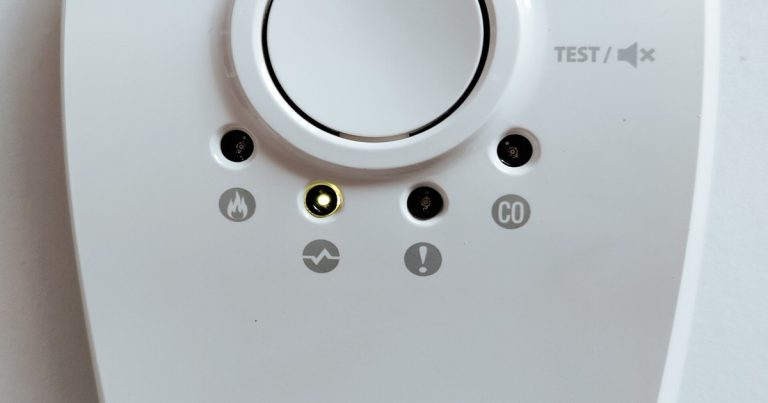
- A smoke alarm, and a CO alarm if you burn anything. That is €20 to €40 that is not up for debate.
Connected or not: the honest calculation
The premium for a connected appliance ranges from €30 (Philips 3000 versus an equivalent basic fan heater) to €130 (Mill versus a non-connected silent panel). The real savings from good scheduling sit between 10 and 20% of the appliance’s consumption, i.e. €12 to €30 per winter in our €144 scenario. In other words: the premium is paid back in one to four winters, not in one month. So the right question is not “connected or not” but “will I actually schedule and control this appliance?”. If the answer is no, a convector with an electronic thermostat at €100 will deliver the same heat for less money.
The calculation changes if you already run a smart home: paired with a temperature sensor and an automation, a connected heater becomes genuine zone heating, running only when the room is occupied and below the setpoint. In that case remote control is no longer a gadget, it is the mechanism of the saving itself. For more on this, our guide to home energy monitors explains how to measure the real effect on your bill, and our comparison of Matter smart home hubs helps you choose the brain that will drive the system.
How to integrate it into your smart home (without picking the wrong protocol)
Let us be clear: as of October 2026, no space heater on the French market is Matter-certified. Matter does not yet have a device type dedicated to space heating, and manufacturers stick to their own apps, with Alexa and Google compatibility obtained through the cloud. Three approaches genuinely work.
- The Matter smart plug with power monitoring. You plug the heater into it, leave the appliance’s own thermostat at maximum, and control the on/off through the plug. You gain automation and measurement without depending on the manufacturer’s app. It is the most robust and cheapest option: expect €20 to €30 for a Matter smart plug.
- Home Assistant integration. Some brands have community integrations, others do not. Check availability and quality before buying: an unmaintained integration breaks at the first manufacturer firmware update.
- The manufacturer’s app alone. That is the case for the Philips 3000, the Dreo and the Mill. It is enough to schedule and pre-heat, but the appliance stays isolated from the rest of the house.
One last architectural point: a space heater is not a main heating system. If you want to control the heating of the whole house, the right component is a smart thermostat or connected thermal storage radiators. A space heater heats one room, for an hour, for a season. And if your home already has a reversible heat pump, an electric space heater becomes a costly duplicate: a heat pump delivers 3 to 4 kWh of heat per kWh of electricity, against 1 for a resistance.
The five most expensive mistakes
- Under-sizing. A 1,500 W unit in a 30 m² living room runs continuously, draws more than a correctly thermostatted 2,000 W heater and still does not heat the room. Power is chosen by floor area, not by price.
- Over-sizing. A 2,500 W unit in 10 m² reaches the setpoint in five minutes then cycles constantly: discomfort and wear. The thermostat compensates partly, not fully.
- Leaving the setpoint at 24 °C. Every degree above 19–20 °C costs about 7% more energy. On a space heater that is several tens of euros per winter.
- Buying connected and never scheduling. This is the most common case: the app is installed on day one, then forgotten. The premium is wasted.
- Heating an empty room continuously “to keep the damp away”. A dehumidifier uses ten times less energy than a space heater to solve a humidity problem: see our comparison of smart dehumidifiers.
Our testing method
We followed six appliances over three weeks, from 25 September to 18 October 2026, in two homes: a poorly insulated 1975 flat (72 m², single glazing) and a 2015 house (110 m², RT 2012). Each appliance was assessed on six criteria scored 1 to 5: thermostat accuracy (checked with a data logger 50 cm from the unit), warm-up speed, sound level measured at 1 metre, app and scheduling quality, consumption measured on an instrumented plug, and safety (surface temperature, tip-over switch, IPX4). Final scores are weighted: thermostat 30%, measured consumption 25%, noise 20%, app 15%, safety 10%. Prices are those observed online during the period, excluding flash sales. No manufacturer had any say in this ranking.
Last updated: 18 October 2026. Prices and models move fast at the start of the heating season; we re-check this selection before every winter.
Frequently asked questions
What is the best smart space heater in 2026?
The Philips 3000 Connected, around €70, offers the best price-to-features ratio: 2,000 W, a thermostat adjustable to the degree from 1 to 37 °C and app-based scheduling. For a bedroom where noise is a deal-breaker, the Mill 1200 W Wi-Fi (~€170) is a better fit despite its limited power.
Does a smart space heater use less energy than a conventional one?
No, not at equal power and duration: 1 kWh of electricity produces 1 kWh of heat whether the appliance is connected or not. The savings come from scheduling and automatic shut-off, which avoid heating an empty room — 10 to 20% of the appliance’s consumption in our test.
Can a space heater be controlled through Matter?
Not natively in October 2026: no space heater on the French market is Matter-certified, because the specification has no dedicated device type for supplementary heating. The reliable workaround is to plug the appliance into a Matter smart plug with power monitoring and control the on/off through the plug.
How much power do I need for a 15 m² bedroom?
Expect 1,200 to 1,500 W for a correctly insulated 15 m² room (the 70 to 100 W per m² rule). A thermostatted 1,500 W unit is preferable to a 2,000 W one that cycles constantly: it heats more slowly but more evenly, and uses the same energy in the end.
Can a space heater be left on all night?
A recent electric appliance fitted with a thermostat, overheat cut-off and tip-over switch can run overnight provided it is clear of obstructions (one metre of free space around it) and plugged directly into a wall socket. Combustion appliances (gas, paraffin) should never run in a closed room, and a fan heater should not be left unattended in a child’s bedroom.
How much does one hour of heating at 2,000 W cost?
About €0.40 per hour at full power, at the regulated tariff of €0.2001 per kWh including tax in force since 1 August 2026. Over four hours a day for ninety days that is €144 — more than the price of the appliance.
Can a space heater replace the main heating system?
Not economically: at €0.20 per kWh, direct electric heating is the most expensive option per kWh of heat, unless it is produced by a heat pump (3 to 4 kWh delivered per kWh consumed). A space heater is for heating one room occasionally, not for replacing a boiler or a heat pump.
Does it need a special socket?
A standard 16 A wall socket is enough up to 3,500 W, so for every appliance in this comparison. Never use a power strip or an extension lead: at 2,000 W the continuous 9 A current heats up the contacts of a cheap power strip, which is the leading cause of fires linked to these appliances.
Is eco mode worth anything?
It reduces maximum power or lowers the setpoint, which cuts actual consumption but also slows warm-up. On a correctly sized and thermostatted appliance, eco mode adds nothing over a well-set target temperature. On an oversized appliance it prevents constant cycling and improves comfort.
Which space heater for a bathroom?
An IPX4-rated bathroom model, installed outside zone 2 (more than 60 cm from the bath or shower). Ceramic fan heaters around 2,000 W such as the Rowenta Instant Comfort Aqua (~€65) are designed for this: fifteen minutes of fast heat, then off.
Smart space heater or connected radiator?
A connected radiator is wall-mounted, heats continuously and replaces an existing emitter: it is main heating, at €300–500 per unit. A space heater is portable, stores away in summer and costs €60–200. If the room is used every day in winter, the radiator pays off better; for an office used three hours a day, the space heater is enough.
Sources and references
- French Energy Regulatory Commission (CRE) — regulated electricity sales tariff, base option, €0.2001 per kWh including tax as of 1 August 2026.
- Commission Regulation (EU) 2015/1188 on ecodesign requirements for local space heaters — the regulatory basis for thermostats and scheduling.
- ADEME — “Se chauffer sans se ruiner” guides and practical fact sheets on space heating (2025-2026 editions).
- Santé publique France — carbon monoxide poisoning surveillance, annual report.
- NF C 15-100 standard — bathroom safety zones and IPX4 protection rating.
- Manufacturer datasheets from Philips, Mill, Dreo, Adax and Dyson consulted in October 2026 for technical specifications.
About the author — Alex Mercer. A technical writer specialising in smart home technology and energy efficiency, he tests connected devices at home and has documented protocols (Matter, Zigbee, Thread, Wi-Fi) since 2019. His comparisons systematically favour measurements taken on an instrumented plug over marketing datasheets. See all his articles.
Also read: if your goal is cutting a heating bill rather than burning wood, the cheapest lever is still room-by-room control. Our 2026 smart pellet stove comparison puts real numbers on pellet payback against gas and electricity — and explains why no pellet stove is Matter-compatible yet.