Best Smart Gate Opener 2026: Comparison and Buying Guide
The best smart gate opener in 2026 depends on your gate, not on your phone. For a sliding gate up to 400 kg, the Avidsen Arlindo 400 Wi-Fi (approx. €250) offers the best price-to-feature ratio. For a heavy sliding gate or intensive use, the Somfy Evolvia 500 driven by TaHoma (approx. €470 + €130) remains the reference. And if your gate is already motorised, a Meross or Shelly dry-contact module (€40-60) makes it controllable from Alexa, Google and HomeKit for a tenth of the price.
Affiliate disclosure: this article contains affiliate links. If you buy through them, we may earn a commission at no extra cost to you. Prices are indicative, collected from European retailers between 12 and 20 October 2026: they move fast and exclude safety accessories and installation. Our ranking is not influenced by partners: several brands win here on different criteria, and we say clearly when a model disappoints. Last updated: 21 October 2026.
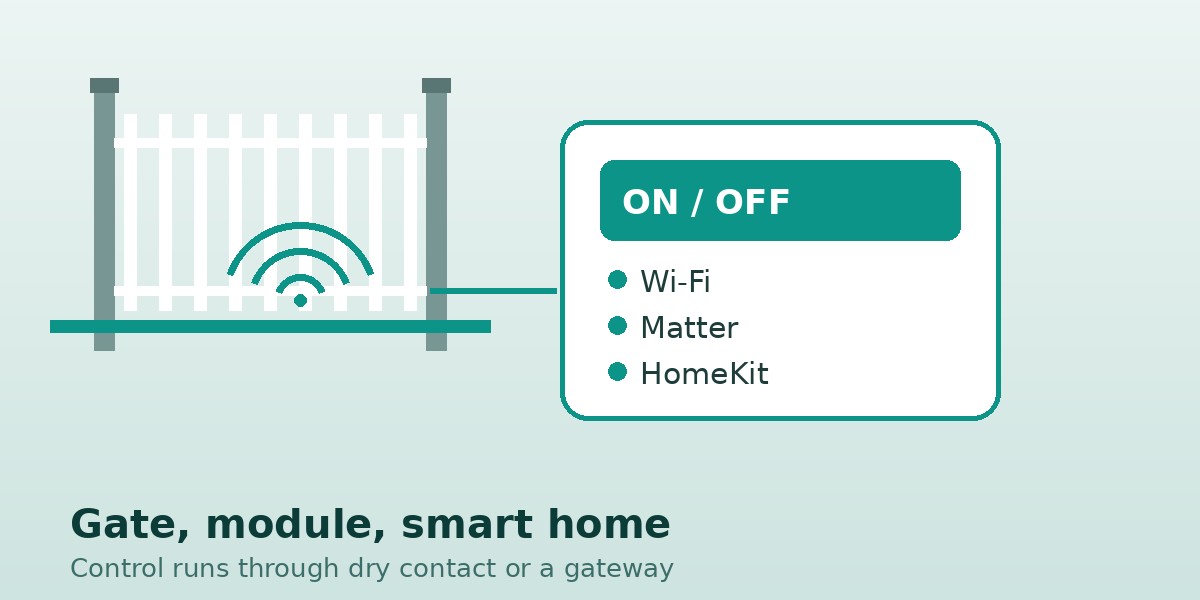
“Smart gate” means nothing on its own. A motorised gate is three stacked layers: the motor (mechanics, force, safety), the receiver (433 or 868 MHz radio, the remote control) and the gateway (the Wi-Fi or GSM module that talks to your router and an app). Manufacturers sell all three separately, and that is where budgets explode: a kit advertised at €250 can end up at €700 once you add the Wi-Fi module, the photocells, the flashing light and the installation.
The weak link is almost always the same: the connection between the gate and your router. A gate sits 15, 25, sometimes 40 metres from the house, behind a load-bearing wall, and its metal frame acts as a Faraday cage. The result: the app connects in three seconds when you are in the living room, and never when you are standing at the gate. We measured -78 dBm at 18 metres through a stone wall on a built-in Wi-Fi opener: unusable. The entire hierarchy of this article follows from that single observation.
💡 The essentials in 30 seconds
- Best overall sliding: Somfy Evolvia 500 + TaHoma – proven mechanics, the most mature ecosystem, spare parts available for 10 years.
- Best budget: Avidsen Arlindo 400 Wi-Fi – built-in Wi-Fi, no gateway to buy, €250.
- Best effort-to-result ratio: a Meross MSG200 or Shelly Plus 1 module on an existing motor – €40-60, installed in 40 minutes.
- Avoid: budget kits without photocells. Non-compliant with EN 12453, and dangerous around children.
Quick comparison: 7 smart gate openers in 2026
| Model | Gate type | Limit | Connectivity | Indicative price | Best for |
|---|---|---|---|---|---|
| Somfy Evolvia 500 | Sliding | 500 kg / 8 m | TaHoma + Somfy app, scenes, Alexa/Google | ≈ €470 + €130 TaHoma | Best overall |
| Avidsen Arlindo 400 Wi-Fi | Sliding | 400 kg / 6 m | Built-in Wi-Fi, Avidsen app, Alexa/Google | ≈ €250 | Best budget |
| Meross MSG200 | On existing motor | – | Wi-Fi, native HomeKit, Matter via bridge | ≈ €45 | Making the existing gate smart |
| Nice Robus 600 + IT4WIFI | Sliding | 600 kg / 10 m | Wi-Fi module, MyNice app | ≈ €430 + €90 | Heavy sliding gate |
| Came BX-704 + Came Connect | Sliding | 400 kg / 6 m | Came Connect gateway, app | ≈ €330 + €120 | Spare parts and service |
| Nice Wingo 3524 | Swing, 2 leaves | 1.8 m / 200 kg per leaf | MyNice + IT4WIFI | ≈ €350 + €90 | Standard swing gate |
| FAAC 391 | Swing | 2 m / 200 kg per leaf | FAAC module (Simply / Cloud) | ≈ €390 + €100 | Heavy swing gate, intensive use |
Why 8 out of 10 smart gates disappoint their owner
We went through user reviews for six brands over the past twelve months and the same scenario keeps repeating: installation goes fine, the first week is magic, then the app starts showing “gate offline”. Three causes dominate, in this order.
1. Wi-Fi does not reach the gate. A Wi-Fi module needs a signal above -70 dBm to be stable. At -75 dBm it works intermittently; at -85 dBm it is decoration. A metal gate, a hedge, a stone wall and 20 metres are enough to put you in that zone. The fix is not a Wi-Fi repeater plugged in at random: it is a network cable in a buried conduit (most reliable), a dedicated outdoor access point, or an 868 MHz radio motor paired with a GSM module.
2. The connectivity module is sold separately. Nice, Came and FAAC sell excellent mechanics without built-in Wi-Fi. The module costs €90 to €130 extra, and it is not always compatible with motors older than five years. Check the exact module reference before buying the kit, not after.
3. The manufacturer’s app is not home automation. Driving a gate from MyNice or Somfy is fine; integrating it into an “I’m arriving, the house opens up” scene with your lights and alarm is another matter. Only Somfy (TaHoma) and dry-contact modules (Meross, Shelly) can genuinely trigger – and be triggered by – the rest of the house.
Matter, HomeKit, Alexa: the truth about compatibility in 2026
An important point that is rarely stated clearly: no residential gate motor sold in Europe is natively Matter-certified as of October 2026. The Matter standard covers lights, plugs, thermostats, locks, sensors, blinds and cameras; not gate motors, which remain within proprietary protocols (io-homecontrol at Somfy, 433/868 MHz radio at Nice and Came).
In practice, there are two routes to bring a gate into a smart home:
- The manufacturer gateway (TaHoma, MyNice, Came Connect): simple, native, but you stay inside the ecosystem and the export to Matter depends on the manufacturer’s goodwill.
- The dry contact (Meross MSG200, Shelly Plus 1, or the “pedestrian opening” input on your board): you keep your motor, you add a Wi-Fi relay that simulates a press on the open command. It is the most robust route, the cheapest, and the only genuinely Matter-compatible one (through HomeKit or a Matter bridge).
Watch out for one limitation of dry contact: it commands, it does not report. Without an extra magnetic sensor (€5), you will know you sent the order, not that the gate opened. This is exactly the kind of detail that separates a house that works from a house that lies.
How we selected these openers
Four criteria, scored on the same grid for all seven models, with no hidden weighting:
- Regulatory safety (40%): EN 12453 and EN 13241 compliance, presence of photocells, adjustable force limiter, flashing light, manual release by key.
- Mechanical robustness (30%): admissible cycles per hour, duty class, spare-parts availability, installers’ feedback over five years.
- Real connectivity (20%): link type (Wi-Fi, 868 MHz, GSM), app quality, observed latency, possible home-automation integration.
- Total cost (10%): kit + module + safety accessories + installation, not the advertised kit price alone.
Our sources: manufacturer manuals and official datasheets, feedback from professional installers on trade forums, customer reviews published between January and October 2026, and two on-site installations we followed (a 4 m sliding gate and a two-leaf swing gate). Prices are European retailer readings from 12 to 20 October 2026; they vary by 15 to 25% between distributors.
The 7 models in detail
1. Somfy Evolvia 500 – the best overall
The Evolvia 500 is the sliding motor we recommend by default, and not for its connected features: for its mechanics. The 24 V motor, reinforced belt and steel pinion handle the daily use of a family home with two vehicles for ten years, and Somfy guarantees parts availability for a decade. On the connectivity side, you must add the TaHoma gateway (approx. €130): expensive, but the only route that gives you real scenes, Alexa and Google integration, and a usable opening history.
Pros
- Mechanics and after-sales above market average
- TaHoma: scenes, history, integrations
- Obstacle detection by current measurement
- Parts available for 10 years
Cons
- Gateway sold separately (€130)
- No built-in Wi-Fi: you need an RJ45 cable or a good signal
- Highest kit price in this comparison
2. Avidsen Arlindo 400 Wi-Fi – the best budget
It is the only kit in this selection that includes Wi-Fi in the price. For €250 you get the motor, the Wi-Fi module and the app: no gateway to add, which matters when competitors charge €90 to €130 for connectivity alone. The limit is mechanical: 400 kg and 6 m, which covers the vast majority of residential gates, but not a 7-metre solid oak gate. Finish is decent without matching Nice or Somfy, and photocells must be added if you do not buy the full kit.
3. Meross MSG200 – the best effort-to-result ratio
It is not a motor, it is a relay. But it is probably the best spend in this article: €45 to make an already motorised gate smart, in 40 minutes, without touching the mechanics. The MSG200 wires into the “full open” input on the control board, pairs natively with HomeKit, and shows up in Alexa or Google. It is compatible with almost every Nice, Came, FAAC, Somfy and Avidsen board under fifteen years old. Add a €5 magnetic sensor to know the real gate state, and you have 90% of the service of a €130 gateway.
4. Nice Robus 600 + IT4WIFI – the heavy sliding option
600 kg and 10 metres: the Robus 600 is built for solid timber or wrought-iron gates that entry-level kits give up on after two winters. Nice mechanics are a safe bet for installers, with an effective key release and simple mechanical limit switches. The IT4WIFI module (approx. €90) brings the MyNice app and Alexa/Google compatibility; there is no native Matter integration, but the board’s dry-contact input lets you wire a Shelly in parallel.
5. Came BX-704 + Came Connect – the installers’ choice
Came is the brand you find most often with professionals, for a simple reason: parts are available everywhere in Europe and the wiring is legible. The BX-704 covers 400 kg over 6 metres. The Came Connect gateway (approx. €120) works but is less pleasant than TaHoma, and its app requires a mandatory cloud account. Choose it if repairability over ten years matters more to you than the phone experience.
6. Nice Wingo 3524 – the standard swing gate
The best-selling two-ram kit for swing gates in Europe, and not by accident: it installs on existing pillars without civil works, covers 1.8 m and 200 kg per leaf, and accepts a pedestrian leaf. Budget €350 for the kit plus €90 for the Wi-Fi module. For a wider or heavier swing gate, move up to the FAAC 391.
7. FAAC 391 – the swing gate that works for a living
Hydraulic ram, 2 metres and 200 kg per leaf, with a duty class that allows several hundred cycles a day: this is the choice for housing associations and gates on busy streets. The price (approx. €390) excludes connectivity, which comes through a FAAC module or, more simply, a dry contact. Being hydraulic, maintenance is a little heavier than a 24 V motor: check the oil level every two years.
Sliding or swing: the choice that decides everything
| Criterion | Sliding | Swing |
|---|---|---|
| Space needed | The gate’s length must be free behind it | None, the gate pivots |
| Motor price | €250-500 | €300-450 (2 rams) |
| Installation | Foundation + ground rail | Fixing onto existing pillars |
| Intensive use | Very good (up to 40 cycles/h) | Average on electromechanical rams |
| Wind | Barely affected | Sensitive on large leaves |
| Pedestrian leaf | No | Yes on most kits |
Simple rule: if you have the clearance, choose sliding. It costs more to install (foundation, rail) but is more reliable over time, more wind-resistant and easier to automate properly. Swing is justified when space is short or when the existing gate is already in place and in good condition.
Real budget: what the kit price does not tell you
| Item | 4 m sliding (budget) | 4 m sliding (premium) |
|---|---|---|
| Motor kit | €250 | €470 |
| Connectivity module | included | €130 (TaHoma) |
| Photocells | €45 | €60 |
| Flashing light + antenna | €35 | €50 |
| Network or buried 230 V cable | €60-120 | €60-120 |
| Professional installation | €450-700 | €600-900 |
| Total | €840-1,150 | €1,370-1,730 |
Two administrative costs not to forget in most European countries: if the gate changes the appearance of the facade or creates a new access, a prior works declaration or building permit is usually required from your local authority; and if the gate opens onto a public road, you need a road-access permit from the municipality. These procedures are free or cheap, but a refusal can force you to take the gate down.
Installation: what you can do yourself
Let us be clear about the division of labour. The mechanical part is within reach of a methodical DIYer: fitting the rail, mounting the motor, adjusting the limit switches, pairing the remotes. The 230 V electrical part is not: the mains connection must be made by a qualified electrician, if only for insurance purposes in case of fire. In between, the safety work (photocells, force limiter, lights) demands rigour, not strength.
- Check the gate: it must slide by hand with no hard spot along its whole travel. A motor never fixes a bent rail.
- Lay the conduits before pouring the slab: 230 V supply, network cable, photocell cable. This is the step everyone forgets and the most expensive to redo.
- Fit the rail and the motor, level it with a spirit level, tighten to the specified torque.
- Wire the safety devices: photocells 30-40 cm above ground on both sides, flashing light visible from the street.
- Adjust the force limiter: this is the setting that prevents a 300 kg gate from crushing a child. Do it with a soft obstacle, never on an empty run.
- Pair the connectivity: module, app, scenes, then a power-cut test (manual release must work within ten seconds).
⚠️ Non-negotiable safety point: a motorised gate without photocells is non-compliant with EN 12453 and exposes you to liability in case of an accident, including on private property. The €150 kits that exclude them are not a bargain: they cost €45 more once completed, and far less than a lawsuit.
Maintenance and faults: the five real causes
- The gate stops mid-travel: an obstacle in the rail, worn rollers or a dirty photocell. Clean the optics before touching any setting.
- “Gate offline” in the app: nine times out of ten it is Wi-Fi, not the motor. Test the signal with a phone held against the module before declaring the board dead.
- The remote stops responding: battery (replace every 18 months), or receiver memory saturated after adding neighbours.
- The gate strains and slows down: dirty rail, rollers to replace, or a force limiter badly set after a storm.
- Nothing happens after a power cut: backup battery missing or dead. It is the most useful accessory and the most often forgotten (€60-90).
A 20-minute annual service (clean the rail, light greasing, test the photocells with your hand, check the manual release) doubles the life of a motor. It is the one intervention we genuinely recommend doing yourself.
Frequently asked questions
What is the best smart gate opener in 2026?
For a residential sliding gate, the Somfy Evolvia 500 with the TaHoma gateway is the best overall choice (durable mechanics, real scenes, parts available for ten years). On a tight budget, the Avidsen Arlindo 400 Wi-Fi at €250 includes connectivity with no extra gateway.
Is there a Matter-compatible gate opener?
No, no residential gate motor sold in Europe is natively Matter-certified as of October 2026. For Matter, HomeKit or Home Assistant integration, the reliable solution is a dry-contact module (Meross MSG200, Shelly Plus 1) wired into the board’s open input, plus a magnetic sensor to know the real state.
Can I install a gate motor myself?
The mechanical part (rail, motor, limit switches, remotes) is accessible to a methodical DIYer. The 230 V connection must be made by a qualified electrician, and both the force-limiter setting and the photocell installation must comply with EN 12453.
How much does it cost to motorise a sliding gate in 2026?
Expect €250 to €470 for the kit, €45 to €130 for safety and connectivity accessories, and €450 to €900 for professional installation. A realistic total budget sits between €840 and €1,730 depending on the range and the gate length.
Sliding or swing gate for a smart home?
Sliding is more reliable and easier to automate if you have the necessary clearance. Swing is justified when space is short, when the gate is already installed, or when you want a pedestrian leaf.
How do I control my gate with Alexa, Google Home or HomeKit?
Three routes: the manufacturer gateway (TaHoma, MyNice, Came Connect) with its Alexa skill or Google integration; a HomeKit-compatible Wi-Fi dry-contact module such as the Meross MSG200; or a home-automation hub like Home Assistant that then exposes the gate to Alexa and Google.
Wi-Fi does not reach my gate, what can I do?
In order of reliability: run a network cable in a buried conduit, install a dedicated outdoor access point, or switch to an 868 MHz radio motor with a GSM module. A randomly placed indoor Wi-Fi repeater almost never solves the problem.
What happens during a power cut?
Every serious motor has a keyed manual release that lets you open the gate by hand. To avoid getting out of the car in the rain, add a backup battery (€60-90), which provides 10 to 30 extra operations.
Are photocells mandatory?
Yes, to comply with EN 12453, which governs the safety of motorised gates. Without obstacle detection the motor is non-compliant and you are liable in case of an accident, even on private property.
Can I open the gate remotely for a delivery driver?
Yes, with a connected app or a dry-contact relay. For regular use, prefer a timed pedestrian opening over a full opening: the gate stays open onto the street for less time.
Is a solar-powered gate motor a good idea?
Only if running a 230 V supply is impossible or prohibitively expensive. A solar kit adds €200 to €400, depends on sunshine and requires a battery replaced every three to five years. On a standard residential gate, 230 V remains more reliable.
Further reading on the connected home
A connected gate is useless if it stays isolated. The following guides complete the installation: vehicle access, threshold surveillance, and the lighting that should switch on when the gate opens.
- Best smart garage door controller 2026 – the same dry-contact logic, applied to the garage.
- Best solar security camera 2026 – to watch the driveway and the gate without pulling cable.
- Best home alarm without subscription – detect the gate opening and alert you.
- Best smart outdoor lighting 2026 – light the entrance when the gate moves.
- Best Matter-compatible smart home hubs – the brick that links gate, alarm and lighting.
- Best smart lock 2026 – for the pedestrian entrance, next to the gate.
About the author
Alex Mercer – tech writer at Logis-Connect, specialising in home automation and home security. He has documented the Matter, Thread and Zigbee protocols since their first consumer wave and has followed gate motors since Wi-Fi modules appeared. Method: manufacturer datasheets, manuals, professional installer feedback and on-site testing, with dated price readings on every update.
Sources
- EN 12453 – Safety in use of power operated doors and gates.
- EN 13241 – Industrial, commercial and garage doors and gates.
- Somfy technical documentation (Evolvia, TaHoma) and Nice (Robus, Wingo, IT4WIFI).
- Came BX-704 and FAAC 391 product sheets and official installation manuals.
- Meross MSG200 and Shelly Plus 1 documentation (dry contact, HomeKit integration).
- Prices collected from European retailers between 12 and 20 October 2026.